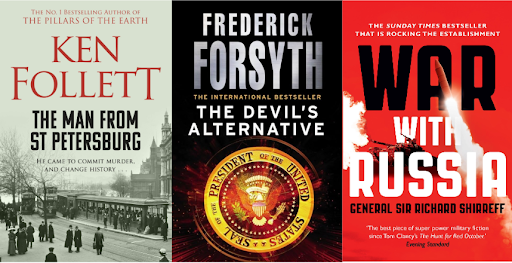
“I cannot forecast to you the action of Russia, it is a riddle wrapped in a mystery inside an enigma; but perhaps there is a key.” Winston Churchill’s iconic admission remains timeless as Russia’s byzantine statecraft—shaped by its revolutions, retreats, and resurgences—continues to send shockwaves across the globe.
From the infamous Molotov-Ribbentrop Pact to the Soviet invasion of Afghanistan, from Nikita Khrushchev’s denunciation of Stalin to Mikhail Gorbachev’s glasnost and perestroika, Russia has a habit of dropping a bombshell, leaving analysts scrambling for answers.
Vladimir Putin checkmated his opponents during Russia’s lightning-fast annexation of Crimea in 2014, and it remains to be seen whether his gambit in ordering the Russian invasion of Ukraine will pay off. But in the grand chess game of geopolitics, understanding the moves requires more than cold analysis. International relations aren’t just about clinical calculations of power. Fiction at its best steps in by providing novel perspectives—expressed through the words and feelings of its characters.
The best historical fiction and political thriller novels not only entertain readers but illuminate the hidden forces at play behind the veil. Beneath the grand official accounts lie the fears, emotions, ambitions, and the long arm of history that drive the decisions of all actors.
The following books set in three different eras of modern Russian history offer gripping narratives that serve as unofficial guides to the motivations behind Russia’s actions in its various avatars.
The Man From St Petersburg by Ken Follett
Ken Follett, well known for his masterful historical fiction novels, delivers a captivating account of political intrigue as tensions rise in Europe before the outbreak of World War I. Determined to enlist the aid of Romanov-ruled Russia, Britain invites Tsar Nicholas’ nephew, Prince Aleksei Orlov, for secret talks with Lord Walden, a respected Conservative who has lived in Russia and is married to a Russian wife, Countess Lydia. Pursued by a ruthless anarchist, Feliks Kschessinsky, who seeks to alter the course of history in a manner similar to Gavrilo Princip, the destinies of these characters become inextricably linked.
Though the novel is primarily set in Britain, the heart of the story originates in St Petersburg, exemplified by the ideological chasm between Prince Orlov and Feliks. One is a reformist nobleman who dreams of the Romanovs regaining their past imperial glory by expanding the Russian sphere of influence; the other, a fanatic nihilist, committed to ending the oppression of Russia’s broken masses by any means necessary. Both characters are visionaries devoted to their respective crusades. Interestingly, this book tells the reader why both causes were doomed to fail, with the Bolsheviks having the last laugh.
Follett paints a vivid picture of political and social life in Britain and Russia during the pre-war years. Each character is well-developed, particularly the Waldens’ idealistic daughter Charlotte. Winston Churchill and Emmeline Pankhurst play small but critical roles in the story. The novel is fast-paced, pays attention to detail, but leads to an inevitable tragic ending.
The Man from St Petersburg plunges readers into a world of aristocratic power struggles, tangled relationships, and revolutionary fervor. Trust me, it’ll be hard to identify the antagonist.
The Devil’s Alternative by Frederick Forsyth
Few authors capture the intricacies of international power struggles at the height of the Cold War quite like Frederick Forsyth.Unknown to the world, a catastrophic grain shortage cripples the Soviet Union. In a desperate bid to regain control, CPSU General Secretary Maxim Rudin engages in a high-stakes diplomatic game with the West, using espionage as his tool. In the shadows, Ukrainian nationalists plot their revenge against Moscow’s supremacy.
The book explores the precarious balancing act of Soviet governance. The aging Kremlin leadership is forced to navigate internal strife, economic turmoil, Ukrainian separatism, and, chillingly, the Red Army’s growing desire for war with the West. Forsyth’s portrayal of the Soviet elite is immaculate as he exposes the ruthless pragmatism and political paranoia that defined their decision-making. The feud between the bureaucracy, party, and military is evident as each plays for its own interests.
At the center of this geopolitical maelstrom is Adam Munro, a British intelligence agent engaged in a forbidden romance with his lover, Valentina, an alleged Kremlin defector. Her information sends alarm bells ringing in Washington, D.C., and London, while the Ukrainian nationalist hijackers of a Swedish cargo ship threaten a massive oil spill in the North Sea, forcing a global standoff.
The Devil’s Alternative presents a chillingly plausible scenario where the stage is set for a superpower showdown, with survival as the desired goal. As the title fittingly suggests, there are no straightforward choices in world politics—each option is more Machiavellian than the next.
War with Russia by General Sir Richard Shirreff
A retired Deputy NATO Supreme Allied Commander, General Shirreff’s novel, published in 2017, brilliantly combines speculative storytelling with strategic analysis. Closely modeled on war game simulations, the author crafts an ominously plausible scenario of Russia invading Ukraine and the Baltic States.
The reader sees the conflict unfold through the eyes of NATO officers, Western politicians, and, of course, the Kremlin syndicate. The novel grippingly depicts modern warfare, where cyberattacks, psychological operations, and political subversion are as significant as battlefield maneuvers.The novel’s protagonists are dismayed by the West’s complacency that emboldens Russia’s territorial ambitions. How effective is the present logic of deterrence, they ask each other. Despite the book’s Western-centric stance, it excellently explains NATO and accurately measures the extent of strategic and military cooperation in Europe. Remarkably, America has a woman president in this book, which will undoubtedly please or annoy several readers.
Shirreff’s narrative highlights how strategic miscalculations and a failure to deter aggression can set the stage for an even larger confrontation. Rich in technical details and a diverse set of characters, the story clearly explains how a security dilemma involving superpowers can result in a cataclysmic conclusion.
“You fail to read this book at your peril,” wrote Admiral James Stavridis, former Supreme Allied Commander Europe. Prophetic words indeed. Shirreff’s War with Russia was vindicated in the spring of 2022.
Russian history and its impact on global affairs are often told in black and white , but fiction allows us to explore perspectives often omitted from mainstream narratives. For students of political science, international relations, or world history, these books aren’t just thrilling reads but essential texts. Historical fiction and political thrillers complement academic reading and news articles by empowering readers to gain new, nuanced perspectives on geopolitics.
In an age of powerful propaganda, the right novel might be the closest we get to the truth. Stimulate your imagination and decode the dilemmas. Happy reading!
Written by Pranav A Menon from India, a third year BSc International Relations Student at the University of London (EMFSS) and London School of Economics and Political Science.


 International angles
Leave a comment