How much was your suit, Mr. President?
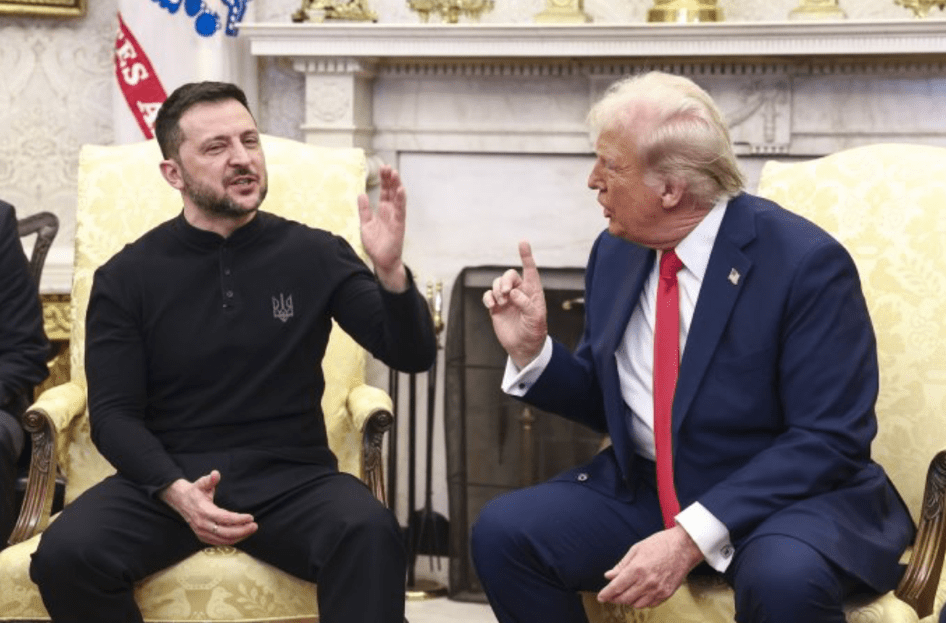
Figure 1-UPI, 2025
As Trump put it: “This is going to be a great television” (Gangitano, 2025). While that might be true for the ratings, it’s hardly the kind of spectacle world leaders hope for in a debate. After all, diplomacy isn’t exactly about drama—it’s about substance. The only substance the world got after their meeting was a tight knot in the stomach and a feeling of anxiety. February 28 witnessed one of the most embarrassing diplomatic moments I have ever seen, with a childish confrontation between the leaders of two countries, leaving people more confused and fearful than ever.
The Meeting’s Key Topics
The main aim of the meeting had to be the mineral deal between the U.S. and Ukraine. According to draft agreements seen by news outlets before the meeting, Ukraine could contribute future revenues from its state-owned mineral, oil, and gas resources to a joint reconstruction fund (Lu, 2025). Before Ukraine’s independence in 1991, its southeast supplied the Soviet Union with key materials for industrialization and military needs, particularly iron, manganese, and coal. By the 2000s, Ukraine became a major producer and exporter of these minerals, along with uranium for nuclear power (Lu, 2025). As Lentschig and Schaik (2025) argues, raw minerals on the territory could cause further conflict in the area, because competition for these resources could lead to heightened tensions and potentially fuel the ongoing conflict rather than resolve it. Given the long-standing importance of minerals from the Soviet era to the present day, it was no surprise that President Donald Trump would seek access to these resources to support Ukraine. So, the main aim of Zelensky’s visit to Washington was to sign the contract and exchange their raw material for the protection of the U.S. Unfortunately, after the heated confrontation between the leaders and journalists, Zelensky left the oval office without signing any documents (Wendling, 2025).

Figure 2- The conversation,2025
What might have caused the public confrontation on television? And why would the leader of the United States want “great television” while having a heated debate with the president, whose country is fighting to protect itself against the aggressor?
In my blog post, I plan to highlight the key moments from the meeting, exploring what might have caused such a heated argument and what parts of the arguments were unreasonable.
Suit, or no suit? That is the question!
“You are all dressed up today” told Trump to Zelensky after greeting with him at White House, unfortunately, this has been a foreshadowing of Brian Glenn’s question: “Why don’t you wear a suit?”, implying that Zelensky was disrespectful for not wearing an “expensive” suit when meeting with the President of the United States (BBC, 2025). However, this was not the case- picture below, show then-British Prime Minister Winston Churchill at the White House during World War II, wearing a “siren-suit”—a one-piece outfit meant to be quickly put on and zipped up when air raid sirens went off (Esposito, 2025). Interestingly, this was not a discussion back then, as people understood that leaders during the war did not have time to dress up in expensive suits. I would argue that Glenn’s comment: “You are at the highest level in this country’s office, and you refuse to wear a suit” (BBC, 2025) was rude and lacked value and appreciation for the situation in Ukraine. President Zelensky was wearing his casual military-style shirt, typically olive green or khaki, during all his meetings with the world leaders. According to Zoya Zvynyatskivska, a Ukrainian fashion historian, comments about clothing are never the cause of prejudice or dislike but rather a reflection of them, and it’s impossible to dress in a way that changes such attitudes (Shulzhenko, 2025). In his interview with the Kyiv Independent, Zvynyatskivska argued: “If Zelensky takes off his military-style outfit and puts on a suit, what does that mean? It means he agrees that the war is over” (Shulzhenko, 2025). Zelensky also mentioned this in his meeting at the Oval Office: “I will wear a costume after this war finishes”, and he continued by stating: “Maybe something like yours, yes. Maybe something better, I don’t know, maybe something cheaper” (Shulzhenko, 2025), implying and highlighting the intensity of the situation in Ukraine and the absurdity of Glenn’s questions.

Figure 3- Esposito, 2025- Churchill during WWII.
Vance’s effort to adapt to the situation
I shall not discuss the showdown in the Oval Office without discussing Vance’s attempt to “contribute” to the conversation and try to disregard President Zelensky. Vance argued that his aim was to “end the war” and argued about the importance of “diplomacy” with Russia’s president- Vladimir Putin (the guardian, 2025). The Vice President tried to adopt a sterner approach to be firmer, as he continued: “Mr President, with respect, I think it’s disrespectful for you to come to the Oval Office and try to litigate this in front of the American media. Right now, you guys are going around and forcing conscripts to the frontlines because you have manpower problems. You should be thanking the president”- to what President Zelensky asked: “have you been to Ukraine to see the problems we have” (the guardian, 2025). There were several things wrong with Vance’s argument- first, Zelensky was not trying to be disrespectful, second of all what is meant by “manpower problems” from the President of Ukraine, where Russia started war for the second time in one decade, is hard for me to understand. Finally, Zelensky expressed his gratitude by repeatedly thanking both U.S. Presidents and the United States as a whole, highlighting Ukraine’s appreciation for their support and assistance during the war. As for whether J.D. Vance has been in Ukraine, he responded that he has seen some pictures of Ukraine, which only made his comment seem even more absurd.
I want to highlight some of the posts by President Zelensky thanking the U.S. and the President Trump, emphasizing the fact that President Zelensky has been thankful for the support from the United States:
December 7, 2024: “I had a good and productive trilateral meeting with President @realDonaldTrump and President @EmmanuelMacron at the Élysée Palace. President Trump is, as always, resolute. I thank him. I also extend my gratitude to Emmanuel for organizing this important meeting” (CNN Politics, 2025).
January 10, 2025: “I spoke with @POTUS and expressed my condolences over the devastating wildfires in California and the tragic loss of lives…I also thanked him for the unwavering support of Ukraine’s independence and for the vital role the United States has played in uniting the international community” (CNN Politics, 2025).
February 12, 2025: “I had a meaningful conversation with @POTUS. We long talked about opportunities to achieve peace, discussed our readiness to work together at the team level, and Ukraine’s technological capabilities—including drones and other advanced industries. I am grateful to President Trump for his interest in what we can accomplish together” (CNN Politics, 2025).
These are examples of instances where President Zelensky expressed his gratitude to both the President and the country for their support in protecting Ukraine.
Have You Been Keeping Up with Putin’s Politics, Mr. President?
Trump has openly called Zelensky a “dictator” on social media, and the President has argued that approval ratings for President Zelensky have fallen to 4% approval rating among the Ukrainian citizens (BBC, 2025). To this claim, a lot of BBC Eastern European Correspondents responded, arguing that “Donald Trump’s latest comments – blaming Ukraine for the war and calling for new elections there – might have come straight from the Kremlin. It seems Vladimir Putin was mightily persuasive on the phone last week” (Rainsford, 2025). This narrative is more connected to Russia’s ongoing propaganda, demonstrating President Zelensky as the “dictator”. Interestingly, when the journalists asked President Trump whether he had changed his opinion about Ukraine’s President, he briefly responded “Did I say that? I can’t believe I said that. Next question” (The Hill, 2025). I would argue that his questionable opinion about President Zelensky was evident during their confrontation in the Oval Office. I shall agree with Pardee professor who claimed that “public brawl could have and should have been avoided” (Boston University, 2025). I don’t fully understand the intention behind this entire scene.
During the meeting, Trump repeatedly argued that once the deal ends, Ukraine wouldn’t need a security guarantee, which I strongly disagree with. Diplomatic relations with Russia have been complicated for two centuries. Additionally, the war in Ukraine began in 2014, and the “pathway to peace” that President Trump often refers to is something I just can’t make sense of. President Zelensky also argued: “None of us wants an endless war, Ukraine is ready to come to the negotiating table as soon as possible to bring lasting peace closer. Nobody wants peace more than Ukrainians. My team and I stand ready to work under President Trump’s strong leadership to get a peace that lasts” (CNN World, 2024). He argued that President Putin broke his agreement to ceasefire 25 times, making it harder to negotiate a final deal with Russia. Even though President Trump is confident that it will not happen during his presidency, without security guarantees, “document is not enough”, Ukraine needs something else, to be sure that there will be no war in the future.
In conclusion, this blog post aims to highlight the absurdity of some claims made during the Oval Office meeting, such as the criticism of Zelensky for wearing a suit, which feels unwarranted, and the portrayal of Ukraine as the aggressor while Russia is framed as seeking peace. Moreover, despite claims that Zelensky never thanked the U.S., it’s important to note that he has expressed his gratitude multiple times, highlighting that such a criticism is both misleading and unfair. While I don’t claim that every word from Zelensky was perfectly “respectful,” it’s important to remember he is a wartime leader. Ultimately, many of the attacks against him seem not only unfounded but also absurd.
My name is Elene Suramelashvili, 23 years old from Georgia, Tbilisi. I did my bachelor’s degree at King’s College London in Philosophy, Politics, and Economics. Currently, I am doing master’s degree at UCL in International Public Policy. Because of Georgia’s political complicated history, politics has been an area of interest from me since high school.
Bibliography:
BBC News (2025). “Trump calls Zelensky a “dictator” as he hits back at “disinformation” criticism”. Available at: https://www.bbc.co.uk/news/live/c62e2158mkpt Accessed: 13 March 2025.
Boston University (2025). “POV: Trump Showdown with Zelensky: What Happened? What’s Next?”. Available at: https://www.bu.edu/articles/2025/trump-showdown-with-zelensky-what-happened-whats-next/Accessed: 10 March 2025.
CNN Politics (2025). “Fact check: 33 times Zelensky thanked Americans and US leaders”. Available at: https://edition.cnn.com/2025/02/28/politics/volodymyr-zelensky-thankful-us-fact-check/index.htmlAccessed: 13 March 2025.
CNN World (2025). “Zelensky describes Oval Office meeting as “regrettable,” says he is ready to negotiate peace”. Available at: https://edition.cnn.com/2025/03/04/europe/zelensky-trump-argument-comment-ukraine-intl/index.htmlAccessed: 8 March 2025.
Esposito, J. (2025). “Photo of Churchill visiting White House in “siren-suit” during WII is authentic”. Snopes. Available at: https://www.snopes.com/fact-check/churchill-siren-suit-white-house/ Accessed: 12 March 2025.
Gangitano A. (2025). “Trump on Oval Office spat with Zelensky: ‘This is going to be a great television”. THE HILL. Available at: https://thehill.com/homenews/administration/5169464-trump-zelensky-great-television/ Accessed: 10 March 2025.
Lentschig, H., & van Schaik, L. (2025). Grabbing Ukraine’s Minerals is a Recipe for Further Instability. Clingendael Institute. http://www.jstor.org/stable/resrep67565
Lu, C. (2025). “Trump and Zelensky’s Week of Whiplash”. Foreign Policy. Available at: https://foreignpolicy.com/2025/03/04/us-ukraine-mineral-deal-rare-earth/ Accessed: 15 March 2025.
Shulzhenko, D. (2025). “Why doesn’t Zelensky wear a suit?”. Kyiv Independent. Available at: https://kyivindependent.com/why-doesnt-zelensky-wear-a-suit/Accessed: 15 March 2025.
The Conversation (2025). “UK-Ukraine deal highlights Ukraine’s wealth of critical minerals but extracting them isn’t so simple.” Available at: https://theconversation.com/us-ukraine-deal-highlights-ukraines-wealth-of-critical-minerals-but-extracting-them-isnt-so-simple-250996Accessed: 13 March 2025.
The Hill (2025). “Trump on calling Zelensky a dictator: “Did I say that?”. Available at: https://thehill.com/homenews/administration/5167646-trump-zelensky-dictator/Accessed 9 March 2025.
The Guardian (2025). “Trump’s explosive clash with Zelensky”. Available at: https://www.theguardian.com/us-news/2025/feb/28/trump-zelenskyy-meeting-transcriptAccessed: 14 March 2025.
UPI (2025). “Donald Trump meets with Ukraine’s Volodymyr Zelensky”. Available at: https://www.upi.com/Top_News/US/Photos/Donald-Trump-meets-with-Ukraines-Volodymyr-Zelensky/15261/ Accessed: 12 March 2025. Wendling, M. (2025). “How criticism of Zelensky’s clothing made it to the Oval office”. BBC. Available at: https://www.bbc.co.uk/news/articles/c1d4r9yvqzpo Accessed: 11 March 2025.


 International angles
Leave a comment