
On March 28, 2025, a powerful earthquake struck central Myanmar, registering 7.7 on the Richter scale. The tremors rippled through an already fractured nation – not just in geography, but in governance, identity, and human suffering. In most countries, such a disaster would trigger a swift and coordinated national response. In Myanmar, however, it landed in the middle of a raging civil war, intensifying an already dire humanitarian crisis.
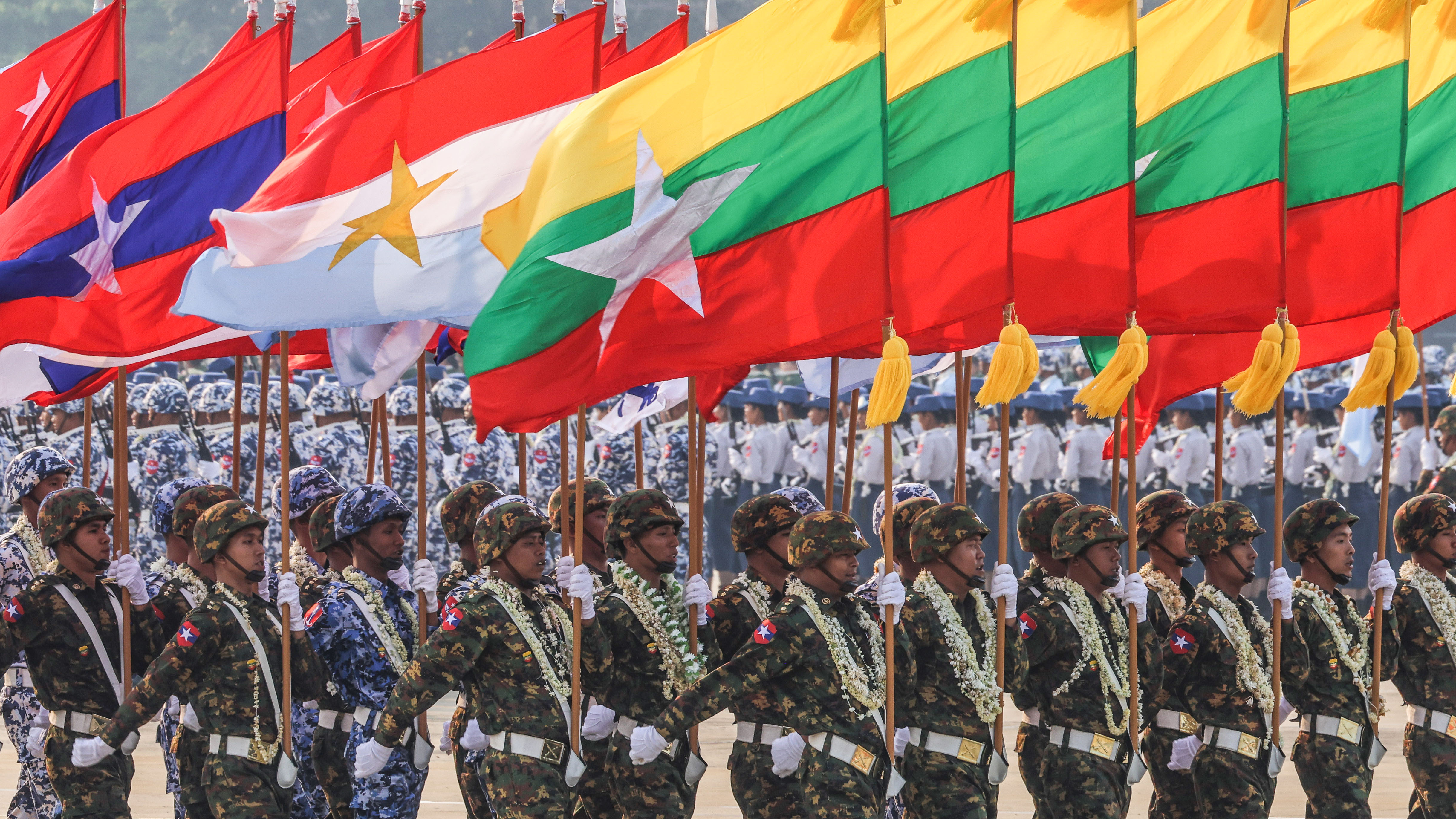
Image available at https://asia.nikkei.com/spotlight/asia-insight/myanmar-military-s-might-fails-to-crush-decades-old-resistance
What Sparked the Current Conflict in Myanmar?
Myanmar’s road to civil war is rooted in a long history of military dominance and political repression. The country was under military rule from 1962 to 2011, during which it was largely isolated from the international community and burdened by sanctions. A shift began in 2011 with the introduction of a nominally civilian government, paving the way for democratic reforms. This culminated in the landmark 2015 elections, where the National League for Democracy (NLD), led by former political prisoner Aung San Suu Kyi, won a landslide victory.
Despite these democratic gains, the military – known as the Tatmadaw – retained significant constitutional power, including control over key ministries and a guaranteed share of parliamentary seats. This fragile democratic experiment came to an abrupt end in February 2021, when the military launched a coup, detaining elected leaders and reclaiming full control.
The coup ignited widespread public outrage. Massive nationwide protests erupted, demanding a return to civilian rule. The military cracked down brutally, using lethal force and mass arrests to quash dissent. In response, many civilians formed grassroots militias known as People’s Defense Forces (PDFs) to resist the junta. These groups soon joined forces with long-standing ethnic armed organizations – such as the Karen National Union and Kachin Independence Army – which have long fought for autonomy or independence.
Since then, the conflict has escalated into a full-blown civil war, spreading even to central regions of Myanmar that had previously remained relatively peaceful. Today, the country is a patchwork of contested territories, with various resistance groups fighting for freedom and the military clinging to power through violence and fear.
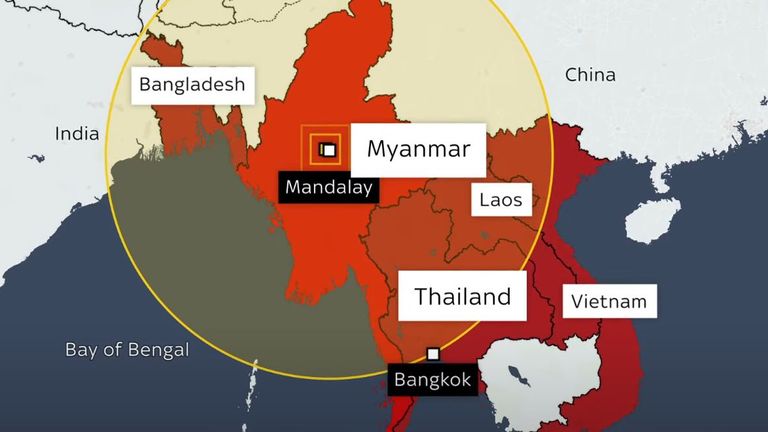
Image available at Sky News
A Seismic Disaster in a Fragile State
The earthquake struck near Magway Region, a part of central Myanmar that has become a frontline in the conflict. It damaged roads, schools, homes, and medical facilities – many of which were already barely functional or operating under strain due to the civil war. The timing could not have been worse. the earthquake did not just shake buildings. It exposed the systemic collapse of governance in Myanmar. And in a bitter irony, nature’s fury may accelerate the humanitarian collapse that man’s actions have already set in motion.
Military restrictions and fighting have hampered access for humanitarian aid groups. The junta has repeatedly blocked or tightly controlled aid to opposition-held areas, weaponizing assistance as leverage. Emergency services are under-resourced, with much of the infrastructure either damaged by fighting or left neglected by the state. Also, the earthquake hit regions with displaced populations living in temporary shelters, now collapsed, worsening their situation even more.
Natural disasters usually lead to a moment of national unity or global solidarity. In Myanmar, they’ve deepened division and suspicion. Relief efforts are faltering. The junta controls all the international assistance, and aid agencies fear this will lead to diversion, corruption, or the use of aid as propaganda. Moreover, the junta has bombed aid convoys it deems “unauthorized,” and often cuts off internet and electricity in restive zones.
In this scenario, the global community, that has condemned the coup and sanctioned the military regime. is now caught in a moral dilemma: how to deliver aid without legitimizing the junta.
Meanwhile, the infrastructure in Myanmar continues to deteriorate. Roads are unsafe due to fighting, and hospitals are under constant surveillance or targeted for sheltering opposition fighters. In many towns, doctors and teachers have joined the civil disobedience movement, leaving essential services paralyzed.
The result is a deadly impasse. Tens of thousands are in urgent need of food, water, and shelter, but no one can get to them safely. This is not a logistical challenge – it’s a political one.
The Human Face of Dual Disasters
Stories from the ground reveal the real cost of this dual disaster.
In Sagaing Region, one of the hardest-hit areas, local rescue and medical teams are overwhelmed by the scale of destruction and casualties. A local resident reported, “Although we are here trying to save lives, we can’t retrieve the bodies or even rescue survivors trapped under the rubble.” They do not hold proper equipment. A former schoolteacher-turned-militia medic explains: “We are not prepared for this. But we are all they have.”
In the town of Pakokku, a mother shelters with her three children in the ruins of her home. Her husband was killed last year in an airstrike by the junta. Now she fears disease from contaminated water and has no access to medicine for her youngest, who is running a fever. A local monastery is the only functioning shelter, overwhelmed and understocked.
The earthquake has not created new victims so much as it has added to the burden of the existing ones – people already displaced, traumatized, and impoverished.
International Response: Treading Carefully
In the wake of the earthquake, the international community has mobilized to provide assistance. The United Nations United Nations Office for the Coordination of Humanitarian Affairs (UNOCHA) has deployed emergency teams to assess damage and facilitate aid distribution.
Western countries face a policy paradox: how to support relief efforts without funneling resources through a regime they do not recognize. At the same time, working directly with ethnic organizations or the NUG risks provoking the junta further. However, the United Kingdom have pledged support through $12 million in in aid for food, water, medicine, and shelter; the United States contributed with $2 million in initial aid.
Some humanitarian organizations, such as the Red Cross and Médecins Sans Frontières, are operating through back channels – quietly coordinating with local groups, using informal networks, and delivering aid in cash or kind. But scale and speed remain huge hurdles due to the junta’s control over aid distribution.
What Comes Next?
The earthquake is unlikely to be a turning point in the civil war, but it may be a tragic accelerator of its worst consequences. Displacement may rise, possibly spilling into neighboring countries like Thailand and India; healthcare systems will collapse further, especially with monsoon season approaching; International engagement may shift, especially due to the escalating tensions between the junta and resistance groups.
Myanmar’s earthquake did not strike a stable country. It struck a broken one – fractured by decades of military rule, ethnic division, and now, full-scale civil war.
For the people of Myanmar, this moment is a reminder that nature does not discriminate – but politics does. A country can survive a quake. Surviving a civil war, on the other hand, requires political will, empathy, and ultimately, a return to democracy and peace.
Myanmar needs more than sympathy. It needs sustained international pressure on the junta, more creative and flexible humanitarian support mechanisms, and – most critically – a path back to legitimate, inclusive governance. Only then can it rebuild, not just from the rubble of an earthquake, but from the ruins of a dictatorship.
Written by: Sabrina Rizzo, Italian student of international relations



 International angles
Leave a comment