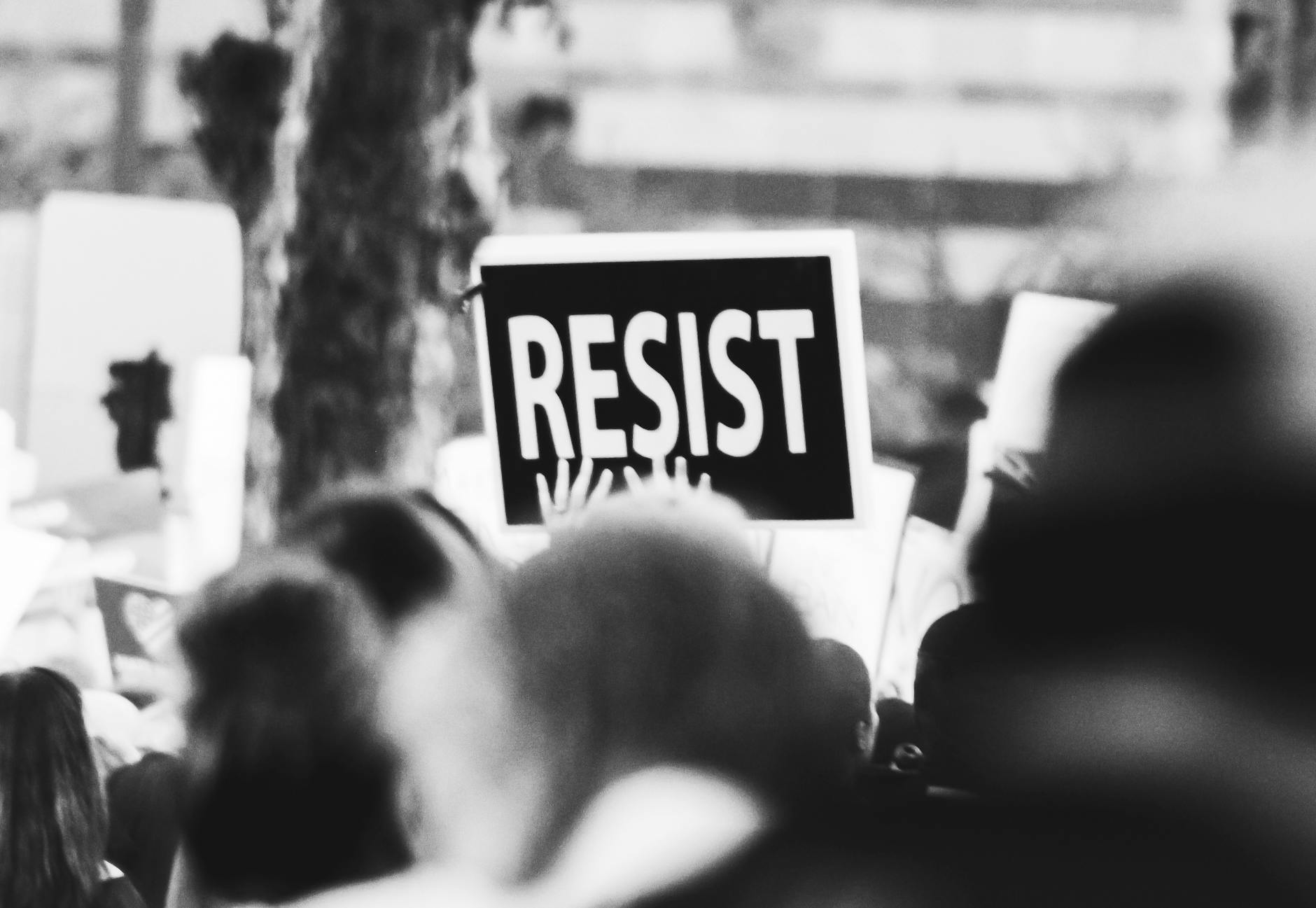
Lately I’ve been thinking about critique in the philosophical sense, critique against the ruling class and the use of voluntary inservitude to amplify that criticism. Woven in this thinking is the strategy of boycotting as the perfect representation of voluntary inservitude, since all it takes is literally to do nothing. These ideas have been echoing in my mind since Trump’s victory and the subsequent boycotting of American products, for instance in Canada because of US tariffs, and the plummeting of Tesla sales.
Most people think that resistance has to be loud, visible, and confrontational, and it’s normal to think so. Yet, there’s something oddly powerful about simply doing nothing. Not just sitting in silence, but performing intentional absence such as refusing to buy, refusing to show up, and refusing to comply. Boycotting can be thought of as an act of critique and, since it’s about people taking action into their own hands, it’s rooted in the Enlightenment tradition and sharpened by modern postmodernist thinkers like Michel Foucault. Boycotting is a form of voluntary inservitude which is a refusal to participate in systems or practices deemed unethical or unjust. We’ve seen it happen all around us, from boycotts of Starbucks in solidarity with Palestine, to entire communities avoiding Tesla and American goods as a protest against Trump’s foreign policy. This text explores how these acts represent not just protest but philosophy in motion, an expression of intellectual and moral autonomy in a globalized and interconnected world. Boycotts can be small yet powerful acts of autonomy, allowing individuals to assert their own ethical frameworks against larger systems of power.
What is critique?
Philosopher Michel Foucault once asked, “What is critique?” His answer was not about yelling at authority or burning flags. Instead, he described critique as “the art of not being governed quite so much.” It’s a kind of refusal, a decision to question, resist, and step outside systems of domination. Critique isn’t always loud or dramatic. Sometimes, it’s simply not showing up, not buying, not celebrating. Just saying ‘no, I won’t participate or obey.’ Critique isn’t just a one-time protest, but a continuous act of non-compliance, an ongoing process of refusal that allows individuals to maintain their autonomy within a world full of pressures and temptations. This idea builds on Enlightenment thinker Immanuel Kant, who believed that critique was the foundation of human maturity. In his view, being enlightened was about daring to use your own reason, to think for yourself instead of blindly following orders or customs from authority figures. To Kant, critique is about freedom through reason. But where Kant focused on individual reasoning, Foucault looked at how power operates in everyday life. For Foucault, critique is less about achieving a state of enlightened thought and more about resisting domination in specific contexts. Whether it’s government surveillance, workplace hierarchies, or political propaganda, critique is the practice of saying ‘no’, even when it’s uncomfortable.
Long before Kant and Foucault, 16th-century French writer Étienne de La Boétie introduced the idea of voluntary servitude. His argument was simple but radical. He said that tyrants only exist because people allow them to. According to La Boétie, people don’t obey because they’re forced to, they obey because they’re used to it. Because the ruling class has internalized rules, customs, and stories to shape society, an idea later made popular by Karl Marx. In La Boétie’s sense, if people simply stopped cooperating, the system would collapse. His insight remains relevant today and this idea of voluntary servitude is echoed in modern critiques of capitalism, where people often continue to support harmful systems out of habit or apathy. Boycotting is, in essence, the decision to no longer cooperate with these systems, the conscious refusal to continue participation in structures that perpetuate harm.
Boycotting as voluntary inservitude
Voluntary inservitude is the decision to stop cooperating and that’s exactly what boycotting is. Let’s take Tesla for example. In recent months, social media has seen a surge in calls to boycott Musk’s company, driven by his cooperation with President Trump and the works of his DOGE department. These boycotts aren’t just about cars. They’re about visibility, power, and morality. By refusing to buy Tesla products, consumers are engaging in a kind of silent protest, not through slogans, but through their wallets. It’s a way of saying that we see what’s happening and we won’t be a part of it. This act of refusal is an attempt to hold corporations accountable, using economic power as a form of critique.
This isn’t new. During apartheid in South Africa, international boycotts of goods and institutions played a crucial role in delegitimizing the regime. Today, many view consumer choices as a powerful, if imperfect, force for ethical resistance. Whether it’s avoiding Starbucks or McDonald’s, refusing to watch certain films, or steering clear of American tech companies, each decision becomes a micro-act of critique. When enough individuals refuse to participate, it sends a message to corporations, governments, and institutions that certain behaviours or policies will not be tolerated. Over time, these individual actions build into larger movements that can change the course of history. What makes these acts so compelling is how they align with the concept of voluntary inservitude.
Unlike traditional protest, which often demands noise, confrontation, or even violence, boycotts are acts of withholding and require long-term discipline. They are powerfully passive, yet deeply intentional. You’re not toppling governments or marching in the streets. You’re just saying no. And yet, in that no, there’s immense power. It’s the kind of power Foucault believed resided in critique, the ability to disrupt dominant narratives by refusing to comply. When people boycott a product, a brand, or even a celebrity, they aren’t just making an economic choice. They’re making a philosophical statement about the kind of world they want to live in. They’re refusing to serve systems that don’t align with their values and that, in a very real sense, is what La Boétie meant by toppling tyranny through non-cooperation.
Kant argued that moral action comes from autonomy, from acting according to principles we’ve rationally chosen, rather than simply following orders or trends. A boycott, when done sincerely, is a perfect example of that. It’s not reactive. It’s not just cancel culture or jumping on a bandwagon. It’s an act of reasoned dissent. This becomes especially powerful when the boycott involves personal sacrifice such as skipping out on convenience, status, or profit. Think of the workers who speak out against unethical employers, even when it risks their livelihood. Or the artists who withdraw from events sponsored by questionable corporations. Or the influencers who lose brand deals for taking a stand. These are acts of critique. They show us what it looks like to choose principle over comfort. In this way, boycotting can be seen as a form of personal integrity, where individuals take moral stands, even when it costs them something personally.
A public thing
However, boycotts don’t just live in the private sphere. They’re also deeply public and that’s part of their strength. Kant believed in the importance of “public reason” or the ability to openly question authority and share ideas for the sake of collective enlightenment. Public boycotts do exactly that by drawing attention to injustices and inviting others to think. In the digital age, boycotts have become more public and widespread, amplified through social media platforms where people can rally others to join their cause. This creates a ripple effect, where one person’s boycott can inspire many others, thus turning individual acts of critique into collective movements for change. When millions of people post about boycotting a brand online, it’s not just a single moment. It’s part of a larger cultural conversation about ethics, power, and complicity, and while critics argue that boycotts are merely symbolic and even ineffective, history tells us another story. From the Montgomery Bus Boycott to global campaigns against apartheid, these acts of voluntary inservitude have left lasting marks on societies. Boycotts have demonstrated time and again that collective non-cooperation can lead to tangible change. In a world where we’re constantly being nudged to consume, obey, and go with the flow, simply stopping and withholding our cooperation is an act of courage. Whether it’s refusing to attend a tech conference sponsored by unethical donors, or choosing not to buy from a company complicit in injustice, these small decisions stack up. They reveal the cracks in systems, they force conversations and sometimes, they bring about change.
Critique, after all, isn’t just about what we say. It’s about what we refuse to do. We often underestimate the power of ‘no.’ But history and philosophy tell us otherwise. Boycotting, as a form of voluntary inservitude, allows ordinary people to challenge authority without violence, protest injustice without spectacle, and reclaim their agency in a world that thrives on passive compliance. So next time you wonder if doing nothing can matter, remember this: not buying, not showing up, not supporting is doing something. That’s critique, that’s resistance, and that’s freedom.
Written by Baldvin, who is studying Politics, Philosophy, & Public Affairs at the University of Milan.



 International angles
Leave a comment