The trade war has begun. Donald Trump has unleashed his full economic arsenal, not only against China but also against the United States’ closest allies, including the European Union. However, what if we were to discover that Donald Trump is not actually Europe’s greatest trade enemy? In reality, another global superpower imposes much higher tariffs than the ones introduced by the new White House occupant. Surprisingly, this superpower is not Russia, China, or the Mercosur countries. The greatest trade enemy of Europe is none other than Europe itself.
Consider the words of Mario Draghi, ex president of the European Central Bank:
“Forget about the United States – Europe has successfully imposed tariffs on itself. EU’s long standing inability to tackle its supply constraints, especially its high internal barriers and regulatory hurdles. These are far more damaging for growth than any tariffs the US might impose — and their harmful effects are increasing over time”
Mario Draghi (Source: EU Trade; Financial Times; 2025)
The European Union carries the concept of union in its name, and not without reason. In many ways, European countries are much more connected to each other than to nations outside the continent. For example, 15% of European students study abroad, compared to just 1% or 2% of American students. Additionally, half of the CEOs of Europe’s 20 largest companies were not born in the country where they work, compared to 20% in the U.S. and virtually 0% in China.
On paper, the European Union is a single market, a region where goods and services can move freely without barriers. In reality, however, this ideal is far from the truth. Each member state employs its own tricks to shut its borders to fellow EU members. The impact of these internal obstacles on trade is far greater than anything the US could impose.
For instance, a study by the International Monetary Fund (IMF) estimated that regulatory barriers in the services sector act as an effective tariff of over 100% for fellow EU countries. That means European businesses face restrictions equivalent to doubling the price of their services when selling across borders within the EU.
A Fractured Union
Another example of Europe’s self-imposed division can be seen in military spending.
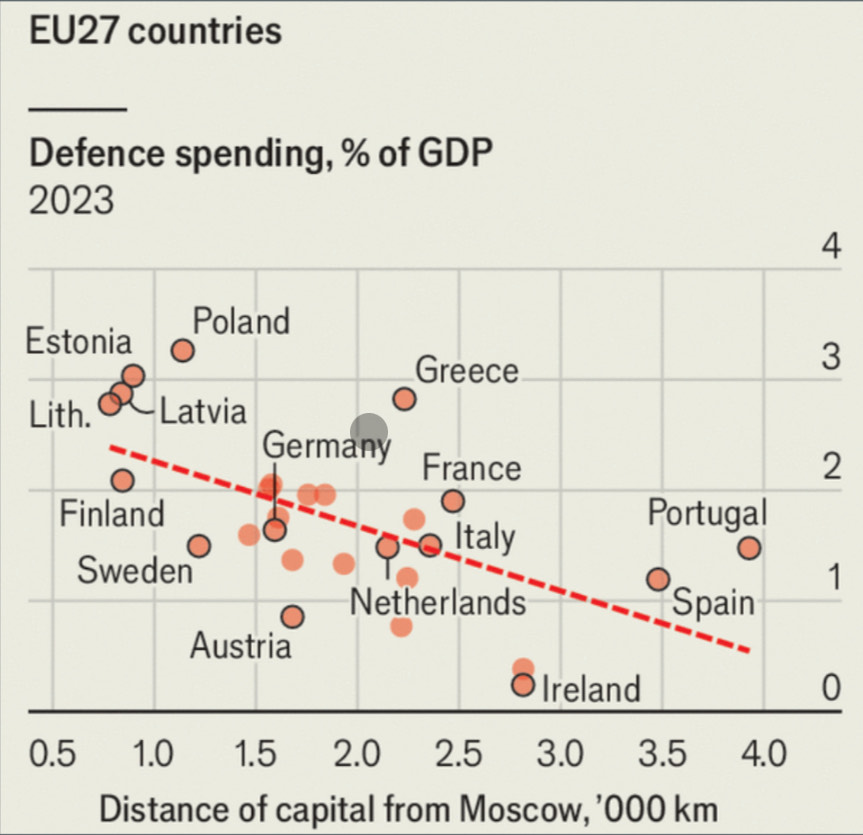
Defense spending, % of GDP by the EU state members (Sources: European Defence Agency; Eurostat; 2023)
The correlation is striking: the further a country is from Moscow, the less it spends on defence. From an individual perspective, this is logical—no Russian tanks will be rolling into Madrid or Lisbon anytime soon. However, the EU is supposed to be an alliance, and in theory, all members should contribute equally to collective defence. In practice, as we can see, that is not the case.
This same fragmented mindset applies to Europe’s supposed single market. In theory, a unified market should benefit all member states equally. In practice, each country prioritizes its own interests, imposing barriers that damage the very economic unity the EU was designed to promote.
A Single Market in Name Only
“In a way, there is a simple, short, and concise answer to this question: in reality, the single market does not exist. It is, in many ways, an illusion. We are about to enter an era where protectionism will be back in fashion—the last thing we need is national protectionism within the European Union…”
European Centre for International Political Economy
One simple, concise answer to this issue is that the EU single market does not fully exist—it is largely an illusion.
Even within the EU, European citizens do not trade with each other as if they belong to a single economic bloc. Consider that: In the US, trade between states accounts for 40% of GDP, whereas intra-European trade only represents 20%—half the level of the United States. This means that despite decades of economic integration efforts, Europeans still do not engage in commerce across borders as seamlessly as Americans do between states.
Paradoxically, the EU is the opposite of Mercosur, the South American trade bloc. Mercosur has promoted trade among its member states while closing itself off to the rest of the world. Meanwhile, despite its single market, Europe exhibits a stronger tendency to trade with external nations rather than among its own members.
That does not mean the single market is a complete failure. Since its establishment, trade within Europe has increased by 63%, a significant achievement. However, there is still much work to be done.
Consider this: If a truly unified market existed, geographical distance would be the most important factor in trade patterns, rather than political borders. Yet, this is not the case.
A Spanish consumer in Andalusia purchases far more Catalan goods than a French consumer living just across the border from Catalonia. Despite having access to a seaport, Catalonia does not trade more with neighboring coastal cities in France. This political bias is evident throughout Europe.
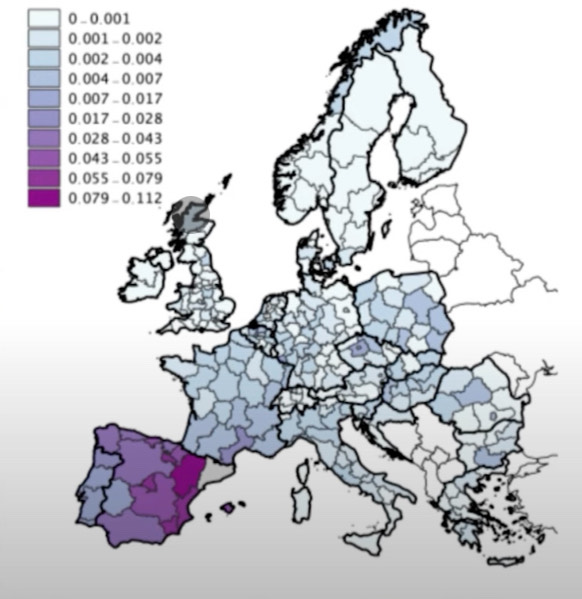
Share of Spending on Catalan Goods (Source: Borders Within Europe;2021)
Not all sectors have benefited equally from the single market, as a comparison.
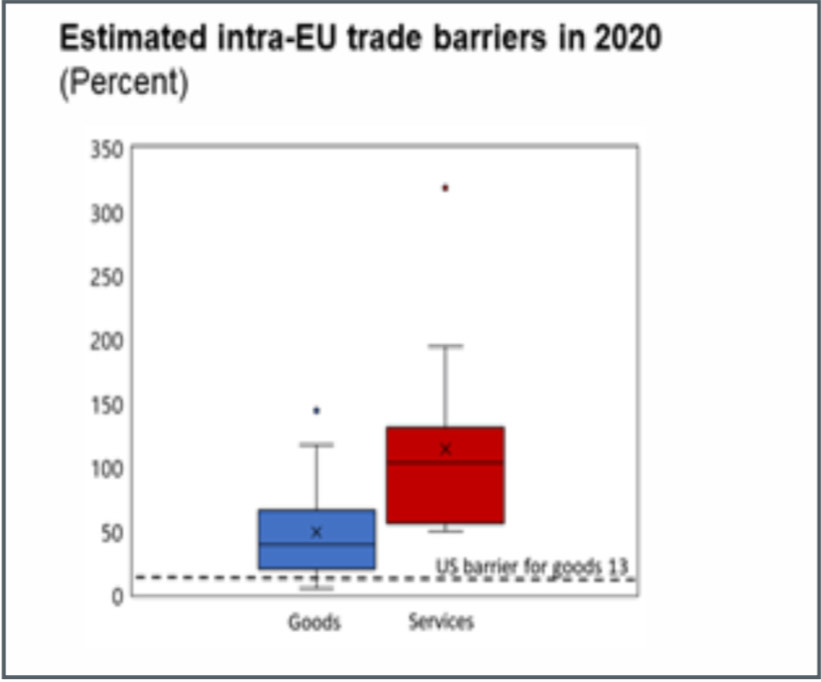
Trade in agricultural products within the EU has increased by 400%. Trade in services has barely changed, remaining at 0% growth.
Inter-Country Input-Output Tina tables; and IMF staff calculations. (Source: Head and Mayer; 2021)
For example, sectors like hospitality, real estate, social assistance, and construction face regulatory barriers that effectively double costs when crossing European borders. In Spain’s Balearic Islands, some politicians have even proposed banning French citizens from buying property, despite both countries being EU members.
The Hidden Cost of Regulation
The impact of Europe’s fragmented regulations extends beyond trade—it also affects consumer prices and business growth. A striking example is the cost of shipping:
• Sending a package from Italy to Austria costs 80% more than sending the same package in the opposite direction.
• In Austria, it is three times cheaper to send a package to a non-EU country than to its immediate neighbor, Italy.
The European Commission itself recognized these issues, commissioning a 260-page report on internal trade barriers—which barely scratches the surface. One of the key findings was that Europe’s regulatory fragmentation is actively harming economic productivity and competitiveness.
“We are entering an era where protectionism will be back in fashion. The last thing we need is national protectionism within the European Union…”
Jonathan Faull
The Real Cost of Fragmentation: Europe’s Business Growth Problem
Beyond direct trade barriers, Europe’s market fragmentation significantly hinders business expansion.
• In China, a single telecom provider serves 400 million people.
• In the U.S., the number is 100 million.
• In Europe, the average telecom provider serves just 5 million customers.
This lack of scale makes European businesses less competitive on the global stage.
Furthermore, European startups struggle to grow. Contrary to common belief, Europe does not lack innovation—new companies are founded at similar rates as in the U.S. However, they stagnate due to an inability to scale.
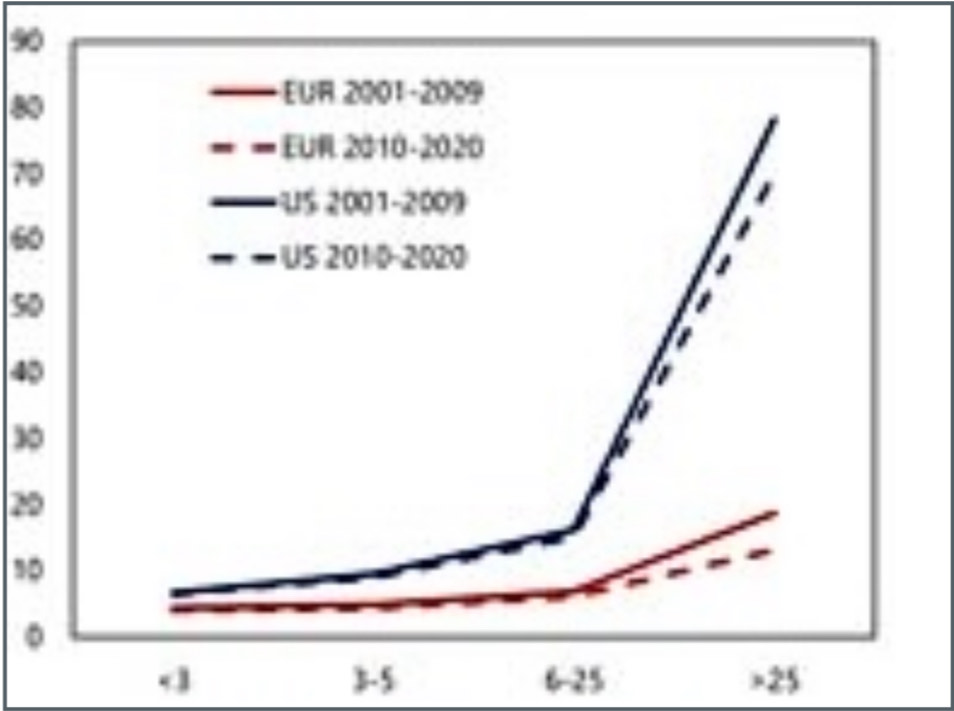
• A 25-year-old U.S. company has, on average, 80 employees.
• A 25-year-old European company has just 20 employees.
Average Employment by Firm Age (Source: Europe’s productivity weakness; Firm-level roots and remedies; 2025)
Without a fully functional single market, no other EU economic policy—whether debt mutualization, a common defense strategy, or a European digital economy plan—can truly succeed.
The Legal and Bureaucratic Maze
Europe’s internal trade barriers are not just economic; they are also legal and bureaucratic.
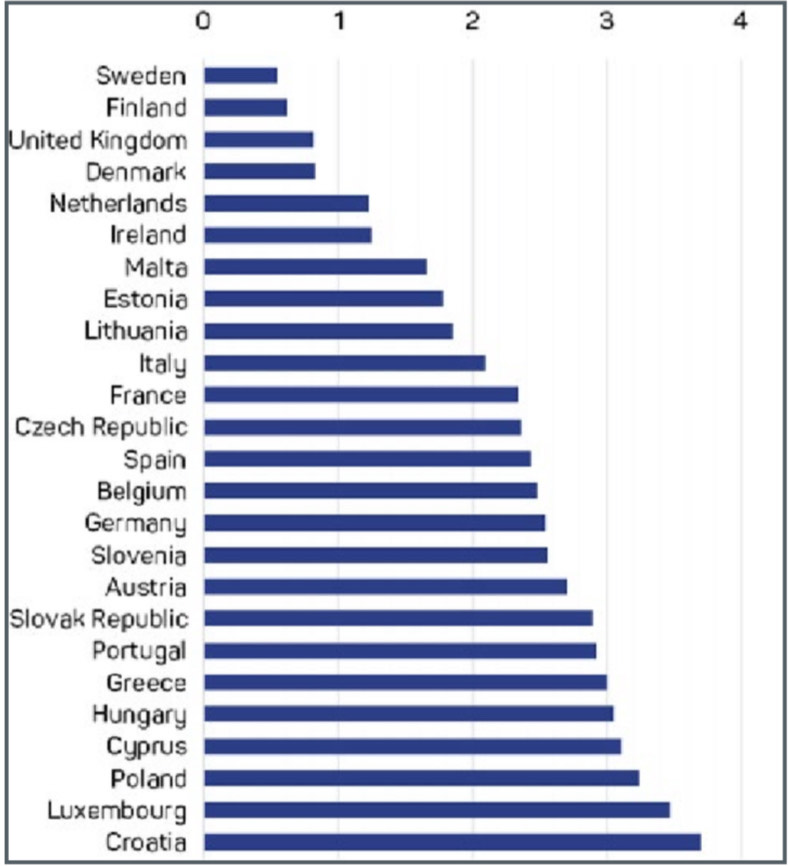
Professional Services Regulation Indicator (Source: OCDE; 2022)
Professional Services Regulation Indicator (Source: OCDE; 2022)
Is There a Solution?
One major obstacle is occupational licensing. While EU regulations technically allow professionals to work across borders, in practice, the process is slow and inefficient.
For example, a Swedish doctor might be denied the right to practice in Greece, even if they meet identical qualifications. Why? Because Greek regulators claim their standards are higher—without real justification.
The European Commission is aware of these issues, occasionally taking legal action against member states that violate single market rules. However, enforcement is weak. Under Ursula von der Leyen’s leadership, legal actions against EU trade violations dropped by 60%.The average resolution time for a dispute? 30 months—almost three years.
In the end, the only consequence for violating single market rules is usually a verbal reprimand.
A Call for Real Economic Unity
European politicians often speak about “European unity,” urging member states to act together in times of crisis. Yet, if they cannot implement the simplest and most beneficial economic policy, how can they hope to succeed in more ambitious projects like Eurobonds or a unified military?
Mario Draghi’s recent report urged European leaders to prioritize the single market. His speech was met with applause. But just two days later, a proposal to reinforce the single market was put to a vote — and rejected by an overwhelming majority.
Europe cannot control Donald Trump’s actions, but it can control its own. And right now, the EU is failing itself.
Written by Alejandro, who is studying Business Administration at the Swiss School of Management.
Sources
– Adilbish, O., Cerdeiro, D., Duval, R., Hong, G. H., Mazzone, L., Rotunno, L., Toprak, H., & Vaziri, M. (2025). Europe’s productivity weakness: Firm-Level Roots and Remedies. International Monetary Fund.
Scaling up the single market to boost productivity. (2024, November 18). IMF. https://www.imf.org/en/News/Articles/ 2024/11/18/sp111424-scaling-up-the-single-market-to-boost-productivity
– Peukert, C., Bechtold, S., Batikas, M., & Kretschmer, T. (2022). Regulatory Spillovers and Data Governance: Evidence from the GDPR. Marketing Science, 41(4), 746–768. https://doi.org/10.1287/mksc.2021.1339 – The Economist. (2025, January 9). Europe could be torn apart by new divisions. The Economist. https:// http://www.economist.com/finance-and-economics/2025/01/09/europe-could-be-torn-apart-by-new-divisions – Draghi, M. (2025, February 14). Forget the US — Europe has successfully put tariffs on itself. Financial Times. https:// http://www.ft.com/content/13a830ce-071a-477f-864c-e499ce9e6065
– Santamaría, M., Ventura, J., & Yeşilbayraktar, U. (2020). Borders within Europe. https://doi.org/10.3386/w28301 – Cappiello, A. (2021). OECD PMR Indicators for Professional Services. Are civil law notaries different? Consumer protection and nature of the notarial services. SSRN Electronic Journal. https://doi.org/10.2139/ssrn.4023378



 International angles
Leave a comment