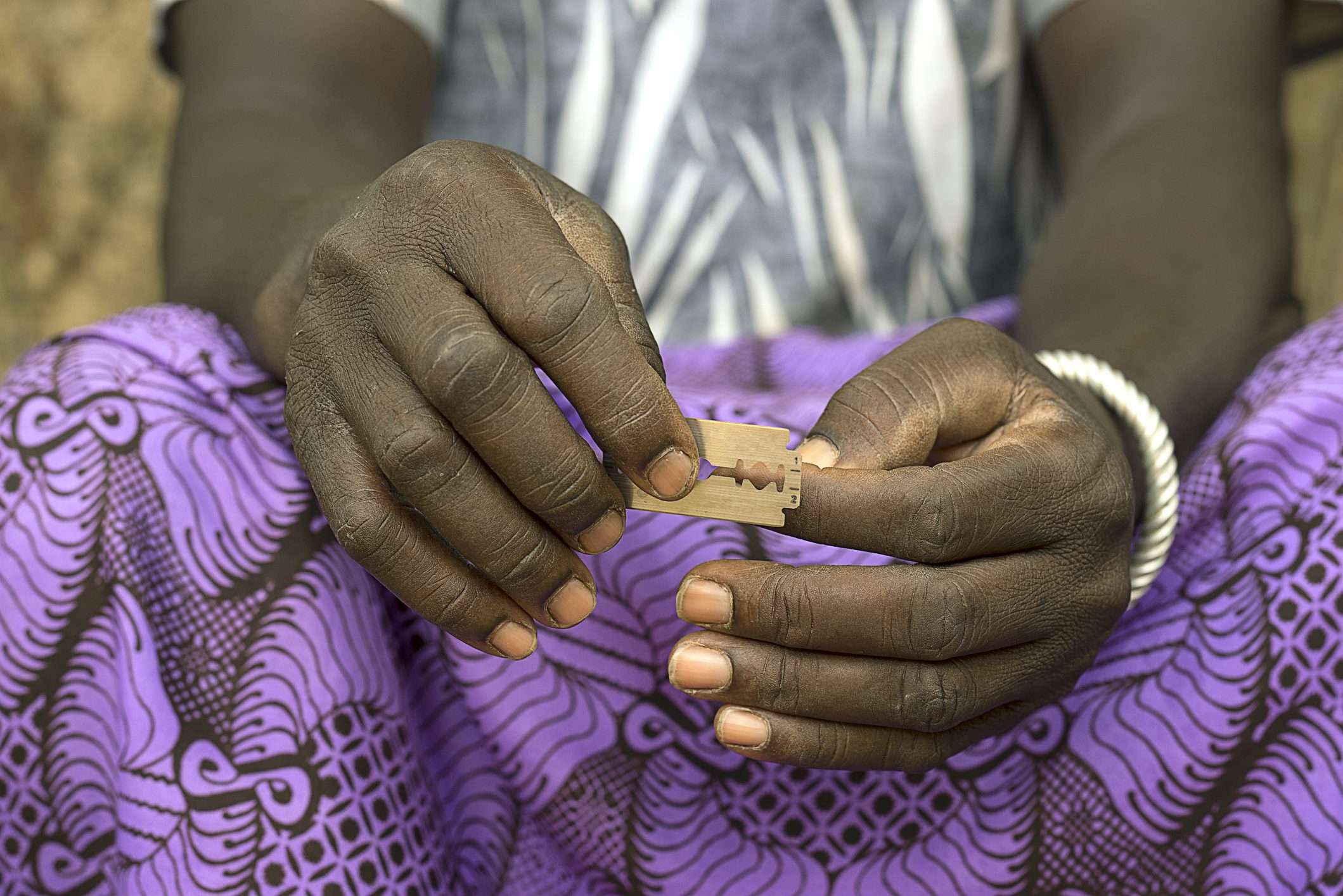
“On top of the overwhelming pain of labor, there was this continuous cutting.” — Sadie Hussein.
Female Genital Mutilation is one of the many ways where women are being discriminated against and harmed in ways that can never justified. Culture and religion are the two main factors behind the reasons that supporters of the practice claim.
From a legal view, Article (2) of The Convention on the Elimination of All forms of Discrimination against Women stated that “ States Parties condemn discrimination against women in all its forms, agree to pursue by all appropriate means and without delay a policy of eliminating discrimination against women and, to this end, undertake: (…) (f) To take all appropriate measures, including legislation, to modify or abolish existing laws, regulations, customs and practices which constitute discrimination against women”.
Leaving no chances of altering existing legislations in regards to the practice, it pursues and provides direct demands of immediate legal elimination. Not only that, but taking the fact that the majority of the victims are young girls aged under 18, the convention on the rights to child have demanded to eliminate the traditional practice and encouraged state scores and administers to act on protecting the victims and prospect victims too.
As stated in Article(37) “States Parties shall ensure that: a) No child shall be subjected to torture or other cruel, inhuman or degrading treatment or punishment. Neither capital punishment nor life imprisonment without possibility of release shall be imposed for offences committed by persons below eighteen years of age”.
Legislative measures shall be made by state actor and administered as an urgent case of human rights violations, this loop of supporting and justifying the practice from a religious and cultural standpoint shall never be considered when the life of women and girls are on the brick. With all the protection and legal means, the practice is still an on-going issue that started to escalate over time, and at times of conflict and international emergency such as COVID-19.
Not only that, but FGM has also had a shifting point where it is being medicalized and practiced by medical practitioners, using medical utilities. The aforesaid has been condemned by Doctors Without Borders as well as WHO, as the ethical standards and dilemma of doctors and healthcare professionals is based on “do no harm” which is based on protecting people and healing them. Instead, the practice of FGM has come on board under the category of medically assisted and it’s where most of the harm is being made and subjected on women and girls.
It is hard to believe that as the world moves forward with conventions and articles protecting women and girls, there are still traditional acts that are making their way through the globalized world, dominating every home and household with its most unjustified arguments that are based on religion and customs that can never be changed or denied. It hurts and it is hard to imagine how many women and girls have gone through the procedure of female genital mutilation. The practice downgrades a woman’s dignity from an honorable and independent individual, to a sexual object that has no role in the modern world except for bearing children and used as a commodity to fulfil the opposite gender’s needs. Our belief that women and girls are safe was, and continues to be short lived.
FGM as a widely known practice that has been practiced throughout history and the modern world too. But what lies behind this method is not something to celebrate. The pain and humility is enclosed in one practice with three types. According to WHO, the first type of FGM is considered as the full or partial removal of a female’s sensitive tissue within the external organ. The second type is based on the full or partial removal of the female labia minora. The third is based on narrowing the female organ’s opening to a minimum, which causes severe pain, long-term complications and even death. No vindication could ever be considered, regardless of whether the arguments are valid in regard to historical evidence or cultural significance.
FGM and Culture
The cultural perspective regarding the support of FGM is based on multiple points, all regulating around the fact that FGM is a form of protection for women and girls against physical harassment and rape. Not only that, but this practice is also viewed as a way of honouring a girl’s purity. In other words, a girl or woman’s dowry and value increases when she has been through the process of FGM. Although it’s being condemned and labeled as an abuse, this practice is continuing to grow amid the concern of legal experts and administrators.
FGM and Religion:
One of the most sincere and emotionally charged arguments in favor of this practice is based on religious beliefs. In traditional societies who practice FGM on women and girls, they argue that religion is their main reason for why they do it. But, religion and religious texts have no connection to the practice. In fact, religious leaders of multiple faiths have condemned such a practice and categorized it as a horrific attack against women and human rights. No text or any written statement has been approved from any religion regarding FGM and officiating it as a religious matter that has to be considered and taken seriously. Taking Islam on one hand, Sheikh Mohammed Abdulahi has declared that
“ the practice has no place in Islam, and despite the challenges of deep-rooted traditional practice, we are committed to completely denounce and challenge the practice”.
On the other hand we have Christianity, as multiple leaders have expressed their views and condemning the practice, that along with Islamic leaders, they have came up with a united publication arguing against the practice and demanding the societies to protect women and girls from such a horrendous situation. In 2016, 3 major publications were published with the partnership between UNICEF, the International Islamic Centre for Population Studies and Research (IICPS), The Bishopric of Public Ecumenical and Social Services for the Coptic Orthodox Church (BLESS). Joint Publication is known as Peace. Love. Tolerance. Key messages from Islam and Christianity on protecting children from violence and harmful practices.
What can we do ?
According to UN Women’s Organization, there are few domestic steps that we as citizens can take and that would lead to changes of first mindsets all the way to actual changes of laws and legal actions.
1- Criminalizing FGM : to condemn the practice and try to talk about it as much as possible so everyone can know and have in-depth information about it and the harm it causes for women and girls. This kind of knowledge has great influence on society and the legality of the action in the long-term.
2- Healthcare Interventions : healthcare professionals shall talk more about the case through their own medical perspective and also discuss how this could lead to immediate death and complications.
3- Working with Traditional and Religious Leaders: as religion and culture are the main factors on why this practice still exists and practiced although all faiths have condemned it and demanded the prevention of such act, people shall still work closely with faith leaders and provide more texts and evidences to make others believe and see for themselves that religion has nothing to do with it. That concerns all religions and faiths.
To conclude, it is important to emphasize and understand the importance of women’s rights, as they are essentially and fundamentally human rights. The world is tending to be a safe place for human rights while excluding the rights of women and girls, folklores and traditional customs are being dragged into the hands of community leaders and activists, making what is known as violence and abuse, something normal and harmless. Religious beliefs and cultural traditions have been taken as a justification for this kind of practice. But the truth to be told, evidences have proved the opposite of it all. As an international and intellectual community of citizens who are concerned and committed about fulfilling our humanitarian duty, we shall always stand against such violence and ignore the justifications that are clearly imaginary ideas formed to make people feel safe and secure in regards to it.
Written By Sawsan Adel, an Author and Postgraduate Student of International Humanitarian Affairs at the University of York.
References :
- Mlaba, K. (2025, February 6). Hidden Scars: Women’s FGM experiences in their own words. Global Citizen. https://www.globalcitizen.org/en/content/hidden-scars-fgm-experiences-quotes-women/
- Female genital mutilation: Quotes. (n.d.-b). http://archive.ipu.org/wmn-e/fgm-quote.htm
- World Health Organization: WHO. (2025, January 31). Female genital mutilation. https://www.who.int/news-room/fact-sheets/detail/female-genital-mutilation
- Female genital mutilation (FGM) frequently asked questions. (n.d.). United Nations Population Fund. https://www.unfpa.org/resources/female-genital-mutilation-fgm-frequently-asked-questions
- FAQs on female genital mutilation: Causes, impact, and how to end it | UN Women – Headquarters. (n.d.). UN Women – Headquarters. https://www.unwomen.org/en/articles/faqs/faqs-on-female-genital-mutilation-causes-impact-and-how-to-end-it


 International angles
Leave a comment