
Have you ever wondered how the foundations of modern Türkiye were laid? Would you believe me if I told you that there was a young leader who laid these foundations and will shape the future? Then, let’s get started…
Mustafa Kemal Atatürk was born in 1881 in Selanik, then a part of the Ottoman Empire. He fought for the independence and sovereignty of the Turkish nation. He is also the founding leader of the Republic of Türkiye. In addition to his military achievements, he carried out many social, cultural and legal reforms to transform the country into a modern, contemporary and secular state. Atatürk was not only a soldier or a politician, but an innovative leader who shaped the future of Türkiye.
Let’s start with the Ottoman Empire. As everyone knows, the Ottoman Empire was a great empire that ruled over vast territories throughout history. But over time, especially towards the end of the 19th century, it started to lose power due to many problems such as economic difficulties, internal rebellions and external pressures. The disintegration of the Ottoman Empire after the First World War did not produce positive results. Throughout the war, great losses were suffered both at the front and behind the front. Naturally, when the war came to an end, the Allied Powers began to occupy the Ottoman lands. With the 1918 Armistice of Mudros, the Ottoman Empire effectively surrendered and the country was occupied from all four sides. Many regions, including Istanbul, were controlled by foreign powers. The people of Anatolia were in poverty and hopelessness. It necessitated a struggle for independence and survival for the Ottoman people and especially for the Turkish nation. With the collapse, a national way of salvation was sought. This path of salvation was shaped under the leadership of Mustafa Kemal Atatürk.He took the stage with a stance that did not bow down to his enemies and all the lights were turned on him. In this dark period when the people were desperate, his light would illuminate this darkness. On May 19, 1919, he landed in Samsun and the Turkish National Struggle, the War of Independence, actually began. Afterwards, Erzurum and Sivas Congresses were convened to ensure national unity and solidarity; protecting the borders of Misak-ı Milli became the most important task and no further territorial loss was desired. The great struggle that would determine the fate of the nation began to take shape.
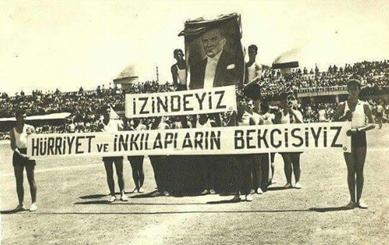
After a great and difficult struggle, the Turkish nation gained its independence and the right to determine their own future. On October 29, 1923, the monarchy, the form of government of the Ottoman Empire, was abolished and the Republic of Türkiye, based on the sovereignty of the people, was proclaimed by the Turkish Grand National Assembly (TBMM). This not only gave birth to a new form of government, but also started the construction of a modern, secular and democratic society for the Turkish people. Following the proclamation of the Republic, Atatürk’s vision led to sweeping reforms to raise Türkiye to the level of contemporary civilization. These changes encompassed not only the political system, but also the legal, educational, social and economic spheres, leading to a fundamental transformation of the country. These reforms, which we call “Principles and Reforms”, laid the foundations of the new Türkiye. They were the most important steps in Türkiye’s modernization and modernization process. Let us now look at what these reforms were, how they were implemented and how they shaped Modern Türkiye.
Republicanism
Let us start with the principle of “republicanism”, the cornerstone of the Republic of Türkiye. The ultimate aim of this principle is the formal separation of state administration from the monarchical order. In other words, it introduced an order in which the country determines its own destiny and the people who will govern the country are determined through elections and democratic means. With the understanding of republicanism, “sovereignty” no longer belongs to the sultan, but to the people. The Republic proclaimed by the Turkish Grand National Assembly is the embodiment of this principle. Under the framework of republicanism, Atatürk made many innovations. He enacted new laws and wanted to strengthen the system. Women were given the right to vote and be elected. “In this regard, December 5, 1934, marks an important milestone when the women of the Republic of Turkey gained the right to vote and be elected earlier than many other countries. This step, encouraging women’s participation in life with equal rights, paved the way for all individuals to lead a more just, egalitarian, and participatory life.”(December 5, 2024, Thursday, Ankara, Turkey — Ministry of Family and Social Services, General Directorate on the Status of Women)

Atatürk’s love and belief in republican governance played a major role in the process of changing the form of government of the Republic of Türkiye. Just as the Turkish Ministry of Education has stated: “Atatürk was a passionate advocate of the republic. At a time when no one dared even to utter the word, young Mustafa Kemal boldly expressed the necessity of abolishing the sultanate and establishing a republic. Especially at the outset of the national struggle, he stated this openly. Around the time of the Erzurum Congress, he explained to his close friends that a republic would be founded. Finally, after the well-known stages, we achieved the republican system. Personal rule and monarchy came to an end.”
Nationalism
Let us continue with another principle, nationalism. Having witnessed many wars throughout history, the Turkish nation is perhaps most conscious of the principle of nationalism. However, Atatürk’s understanding of nationalism is not only linked to “Turkish blood”. According to Atatürkist thought, the Turkish nation is considered to be a society of citizens bound together by unity of language and culture. In other words, there is absolutely no place for racism in Atatürk’s understanding of nationalism and this is rejected. What is important for him is the element of unity and solidarity; therefore race does not matter. The most concrete example of this principle is the Language Revolution led by President Atatürk on July 12, 1932. This reform was initiated through the Turkish Language Institution and the aim was to transform the language into a simple and national language that the public could understand more easily after the Alphabet Revolution in 1928. The Turkish language used in the Republic of Türkiye today is a result of the Language Revolution.
Populism
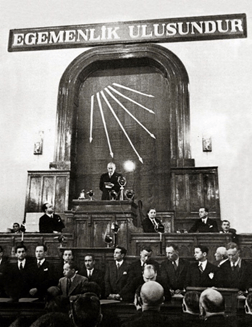
While the principle of nationalism creates a common language and culture among the people, another fundamental principle, populism, advocates that every individual in society should have equal rights, especially before the law, and that discrimination should be opposed. In a sense, populism is a consequence of the principles of nationalism and republicanism. With the declaration of the republic in 1923, it was emphasized that sovereignty belonged to the nation. This means that the people have a say in the governance of the country and that this influence must function in a correct and fair manner. This is where the principle of populism comes into play. Many reforms were carried out within the scope of populism. One of them was the Dress Code Revolution in 1925. The aim of this revolution was to ensure an equal appearance among the people by eliminating differences in religious or class appearance. Thanks to this reform, equality in society came to the fore and the basic steps of the principle of populism were taken.
Statism
Statism, one of Atatürk’s principles, is the cornerstone of the reforms in the economic field. This principle is based on the shaping of the state according to the needs of the country rather than the state taking full control. “Since the newly founded Turkish state was, in economic terms, an underdeveloped country resembling a colonial type, it had to achieve rapid development. Turkey’s development was regarded as a matter of existence or non-existence. Achieving rapid development within a democratic order compelled Turkey to adopt statism, directing state powers toward the welfare of society.” (Hamza Eroğlu, Atatürk ve Devletçilik, Turkish Historical Society). In the early years of the Republic, Turkey’s economy had been severely disrupted by the devastation of the wars. Industry was almost non-existent and infrastructure was very bad. The private sector was not sufficient to solve these problems. In line with these problems, the principle of statism was born. In this context, the state undertook industrial investments; by establishing factories, railways and banks, it succeeded in reaching all areas of the economy and strengthened economic independence. In 1934, with the Five-Year Development Plan, the principle of statism reached an institutionalized structure. Thanks to this plan, industrialization and economic development accelerated in Türkiye.
Secularism
Let’s come to perhaps the most critical principle, secularism. With the adoption of this principle, religion and state affairs in the country are separated. The aim of the principle is to ensure the freedom of belief of individuals, to prevent religion from interfering in state affairs and to establish a modern legal system. In the early years of the Republic, the influence of religion on state control was quite high. In 1924, the Caliphate was abolished. In 1926, the Turkish Civil Code was adopted. Religious rules were replaced by a secular legal system. Thus, religion was removed from areas of law such as marriage, inheritance and divorce and an egalitarian order was established. With the 1928 Constitutional amendment, the principle of “Islam is the religion of the state” was officially removed and religion was left to the freedom of the individual.
Revolutionism
The principle of revolutionism advocates that society and the state should be regularly renewed and progressed according to the requirements of the age and time. Change must always continue because continuous innovation is necessary to reach the level of contemporary civilization. Reformism covers all the reforms I mentioned above, such as the dress code and the alphabet revolution. It is not only a change but also a movement of continuous progress.
Türkiye’s rebirth as a modern, secular, democratic and independent state is thanks to the principles and reforms of Mustafa Kemal Atatürk. These values are not only the guarantee of the past but also of the future. In line with Atatürk’s vision, it is our most important mission as a society to protect these values and carry them forward.

Written by Öykü Senem Çakırca, a student of Political Science and International Relations at Çankaya University
REFERENCES
- Eroğlu, H. (1988). Atatürk ve devletçilik. Belleten, 52(204), 833–848. https://belleten.gov.tr/tam-metin/2048/tur
- https://www.meb.gov.tr/ataturk/Ilkeleri/Cumhuriyetcilik
- Ministry of Family and Social Services, General Directorate on the Status of Women. (2024, December 5). Bakanımız Göktaş, Türk Kadınına Seçme ve Seçilme Hakkı Verilmesinin 90’ıncı Yıl Dönümünde Anıtkabir’i Ziyaret Etti. https://aile.gov.tr/ksgm/haberler/bakanimiz-goktas-turk-kadinina-secme-ve-secilme-hakki-verilmesinin-90-inci-yil-donumunde-anitkabir-i-ziyaret-etti/#:~:text=Bu%20anlamda%2C%205%20Aral%C4%B1k%201934,bir%20ya%C5%9Fam%20s%C3%BCrmesinin%20yolunu%20a%C3%A7m%C4%B1%C5%9Ft%C4%B1r
- https://atam.gov.tr/milliyetcilik/
- https://tr.wikipedia.org/wiki/Dil_Devrimi
- Sancaktar, F. M. (2020). Sivas Kongresi (4-11 Eylül 1919) Delegelerine Dair Bazı Tespitler. Turkish Journal of History, (71), 473. https://dergipark.org.tr/en/pub/iutarih/issue/56577/787310
- https://www.meb.gov.tr/ataturk/Ilkeleri/Halkcilik



 International angles
Leave a comment