
Image available at https://www.krctimes.com
In May 2025, the longstanding tensions between India and Pakistan escalated dramatically, marking one of the most serious confrontations between the two nuclear-armed neighbors in recent years. The immediate catalyst was a terrorist attack on April 22 in Indian-administered Kashmir, which claimed the lives of 26 Hindu pilgrims. India attributed the attack to Pakistan-based militant groups, prompting a series of retaliatory measures.
On May 7, India launched “Operation Sindoor,” a series of precision airstrikes targeting alleged terrorist infrastructure in Pakistan and Pakistan-administered Kashmir. Pakistan responded with its own military actions, claiming to have downed several Indian aircraft and launching retaliatory strikes that resulted in civilian casualties.
Despite a U.S.-brokered ceasefire announced hostilities persisted. On May 13, Pakistan’s military reported that 51 people, including soldiers and civilians, were killed in ongoing clashes. India, meanwhile, has issued stern warnings, asserting its right to retaliate against any further aggression and condemning attacks on religious sites. The situation remains volatile, with both nations engaged in high-level military discussions aimed at de-escalation.
This recent flare-up underscores the fragile nature of peace in the region and the ever-present risk of escalation between these two nations.
The India-Pakistan conflict remains one of the most enduring and dangerous rivalries in modern geopolitics. Rooted in a violent and traumatic partition in 1947, this bilateral tension has evolved into a complex interplay of nationalism, territorial disputes, ideological divergence, and nuclear deterrence. While the past few decades have seen both nations refrain from full-scale war, recent developments in Kashmir, political rhetoric, and cross-border skirmishes continue to highlight the region’s volatility. Today, the threat of escalation is tempered not only by military considerations but also by the ominous presence of nuclear arsenals on both sides.
Historical Context: From Partition to Perpetual Tension
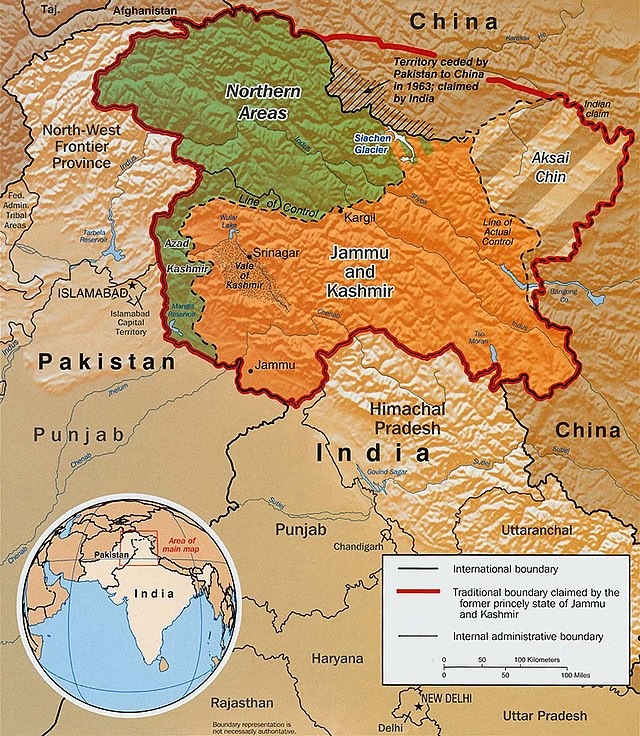
Source: Library of Congress, Geography and Map Division
The conflict began with the partition of British India in 1947, resulting in the creation of two sovereign states: India and Pakistan. The division triggered one of the largest mass migrations in human history and unleashed communal violence that claimed over a million lives. At the heart of the enduring hostility lies the region of Jammu and Kashmir, a princely state whose accession to India remains fiercely contested by Pakistan.
Three major wars (1947, 1965, and 1971), a limited but high-altitude war in Kargil in 1999, and numerous standoffs and skirmishes have kept the region on edge. The Kashmir dispute continues to define bilateral relations, with both sides claiming it in full but controlling it in part. Each military confrontation has underscored not just the intensity of nationalist sentiments, but also the strategic calculations dictated by military capabilities and nuclear doctrine.
Nuclearization and Strategic Deterrence
The nuclearization of the India-Pakistan conflict, initiated by India’s first nuclear test in 1974 (“Operation Smiling Buddha”) and followed by Pakistan’s successful tests in 1998, has significantly transformed the dynamics of the rivalry. With both states now possessing nuclear weapons, the traditional calculus of warfare has shifted toward deterrence and strategic posturing.
India maintains a no-first-use (NFU) nuclear doctrine, emphasizing deterrence and second-strike capability. Pakistan, in contrast, has adopted an ambiguous posture, sometimes described as an “option-enhancing policy” that includes the potential for a first strike under specific circumstances. This asymmetry in doctrine heightens the uncertainty surrounding crisis scenarios and places a premium on credibility and strategic signaling.
Kenneth Waltz’s theory of rational deterrence offers a useful lens through which to analyze this dynamic. Waltz argues that the very existence of nuclear weapons deters war by raising the costs of conflict to unacceptable levels. However, this has led to the stability-instability paradox: while full-scale war is deterred, limited conflicts and proxy engagements become more likely, as was evident in Kargil and other skirmishes across the Line of Control (LoC).
Defensive Realism and the Balance of Power
The strategic behavior of both India and Pakistan can be further interpreted through the framework of defensive realism, a branch of international relations theory that posits states seek security rather than power per se. In an anarchic international system with no central authority, states act rationally to ensure their survival.
In the India-Pakistan context, both countries have repeatedly calibrated their military responses to avoid crossing the nuclear threshold. This was evident in the 2001–2002 Twin Peaks Crisis, triggered by a terrorist attack on the Indian Parliament. Although massive troop mobilizations followed, the crisis was ultimately defused by diplomatic efforts and mutual recognition of the nuclear dimension.
Similarly, during the Kargil War, despite India’s military superiority and the occupation of strategic posts by Pakistani forces, the conflict remained localized due to the looming threat of nuclear escalation. These episodes illustrate how strategic restraint, shaped by deterrence logic, can co-exist with deep-rooted antagonism.
Present-Day Dynamics
As of 2025, India and Pakistan continue to maintain a tenuous peace marked by rhetorical hostility, periodic ceasefire violations, and concerns about cross-border terrorism. The abrogation of Article 370 by India in 2019, which revoked Jammu and Kashmir’s special autonomous status, led to a fresh diplomatic freeze. Pakistan downgraded diplomatic ties, suspended trade, and intensified its international lobbying efforts, particularly at the United Nations and Organization of Islamic Cooperation (OIC).
Cross-border firing along the Line of Control remains a frequent occurrence, despite a reaffirmation of a ceasefire agreement in 2021. Both nations have also engaged in aggressive signaling through missile tests and military exercises. Pakistan’s development of tactical nuclear weapons, such as the Nasr missile, further complicates India’s deterrence posture, particularly in light of India’s growing emphasis on a “massive retaliation” policy.
Furthermore, the growing role of China in the region, through economic corridors and military cooperation with Pakistan, adds a new layer of complexity. India’s strategic partnerships with the United States and participation in the Quad (with Japan, Australia, and the US) are seen in Islamabad and Beijing as attempts to counterbalance regional dynamics.
The Role of Third Parties and Global Implications
Historically, external actors – especially the United States – have played a crucial role in crisis management. During the 1990 Kashmir crisis, Kargil War, and Twin Peaks Crisis, Washington engaged in intensive shuttle diplomacy to de-escalate tensions. Today, global powers continue to monitor the situation closely, given the potential for regional escalation to impact global security, trade routes, and the non-proliferation regime.
Pakistan’s diplomatic strategy has often involved internationalizing the Kashmir issue, while India has consistently resisted third-party mediation, asserting that Kashmir is a bilateral matter. The international community, however, remains concerned about the potential for miscalculation in a nuclearized environment – especially given the relatively short missile flight times and limited crisis response infrastructure in both countries.
A Deterrent Peace or a Permanent Risk?
The India-Pakistan conflict is characterized by paradoxes: the absence of war coexists with the absence of peace, and nuclear deterrence ensures both restraint and instability. The strategic environment is shaped by the doctrines of mutual assured destruction (MAD), rational deterrence, and defensive realism, all of which suggest that despite provocations and crises, neither side has a rational incentive to initiate a large-scale conflict.
However, this balance remains fragile. Emerging technologies, new forms of warfare (including cyber and space), and domestic political pressures could alter decision-making in unpredictable ways. Moreover, non-state actors, particularly in Pakistan, remain a wild card – capable of triggering crises that neither government desires.
Sustainable peace requires more than deterrence. Confidence-building measures, renewed diplomatic engagement, and a rethinking of rigid postures on Kashmir are necessary steps toward long-term stability. As long as strategic logic prevails over emotion and nationalism, the region may avoid catastrophe. But in a world where perception can dictate policy, the line between deterrence and disaster remains perilously thin.
Written by Sabrina Rizzo, student of International Relations



 International angles
Leave a comment