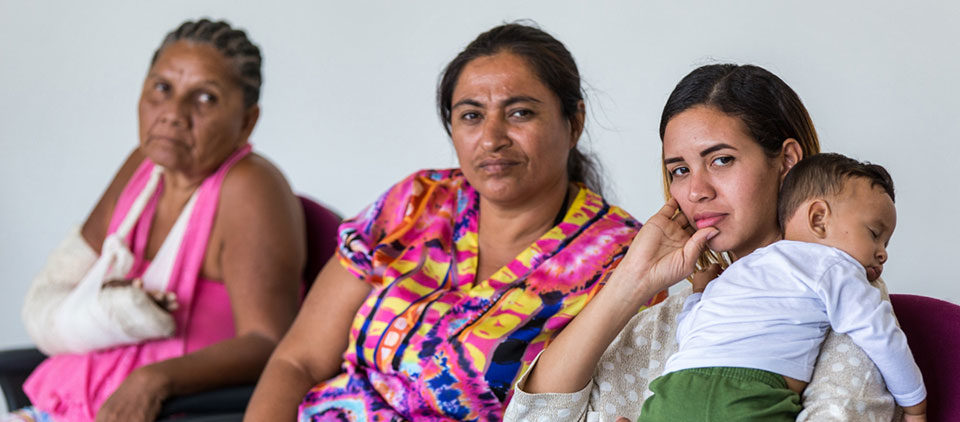
Image courtesy of wphfund.org
Peru has emerged as a central destination for Venezuelans escaping the collapse of their country’s economy and political system. With over 1.6 million arrivals, it now hosts one of the largest Venezuelan migrant populations in the world. Although migration figures and regularization programs dominate the political conversation, far less attention is given to what happens after arrival.
For Venezuelan women in particular, the story is not one of opportunity or inclusion, but of absorption into precarious and undervalued sectors of the labor market. Most find themselves working as domestic laborers, informal vendors, or in the sex trade. Their professional backgrounds and skills are rarely recognized, and their access to stable employment is obstructed by legal, social, and historical factors that reach beyond current policy. These labor outcomes are not accidental. They reflect patterns of inequality that have persisted since the colonial period and continue to define the place of racialized and gendered bodies in Peru’s economic order.
Legal Change Without Structural Reform
Recent migration policy developments in Peru have been framed as progressive and inclusive. Legislative Decree No. 1350, introduced in 2017, formalized a shift toward a human rights–based model. Temporary protection permits and regional agreements have facilitated legal entry for Venezuelans in ways that stand out across Latin America. Yet despite the language of inclusion, the lived experiences of migrant women suggest a disconnect between formal rights and real opportunities. Policies remain largely blind to the ways gender and race shape labor outcomes. Migration continues to be treated as a general category, overlooking how social inequalities determine who ends up where within the economy.
As a result, Venezuelan women are often excluded from formal sectors and directed into informal or stigmatized work regardless of their qualifications. The same women who once worked as professionals, educators, or nurses in Venezuela are now concentrated in jobs that replicate older systems of servitude. Legal status may offer protection from deportation, but it does little to disrupt the structures that marginalize them once they are inside the country.
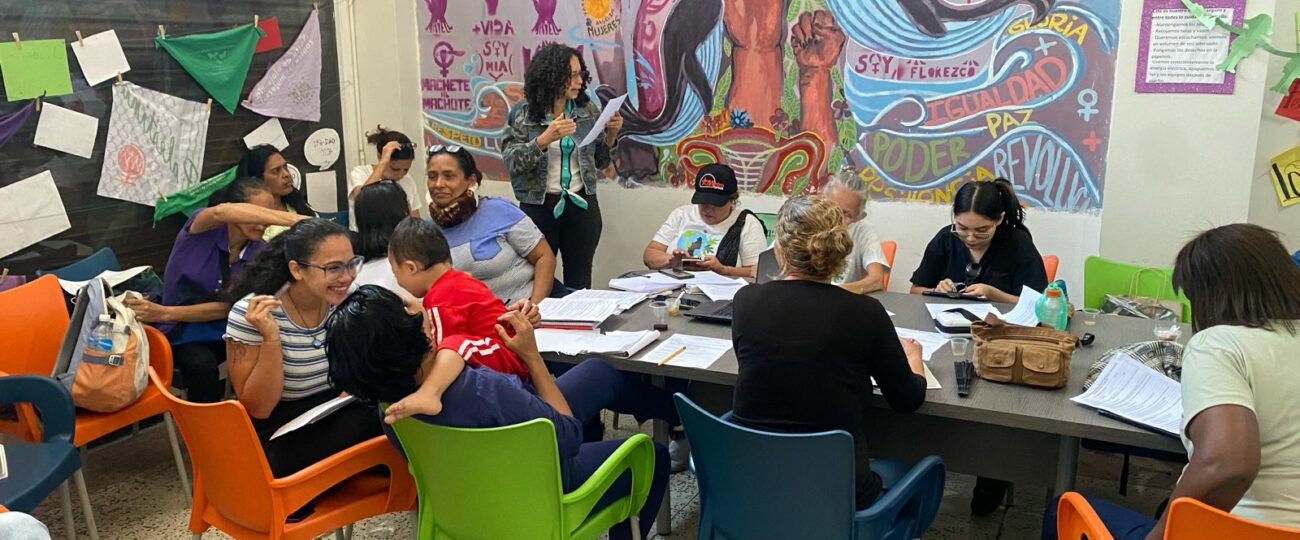
Image available at https://capiremov.org/en/
The Endurance of Domestic Servitude
Domestic work is one of the most common forms of employment for Venezuelan women in Peru. Framed as flexible and temporary, it in fact reproduces long-standing inequalities that define who serves and who is served. Migrant women clean homes, care for children, and support elderly people in arrangements that are often informal and underpaid. These positions are framed as private and intimate, yet they function through control, invisibility, and unequal power.
Employers may describe these relationships as familial, but workers are frequently denied privacy, rest, and even basic protections. Live-in roles tend to blur the lines between labor and surveillance. The labor involved is physically demanding, emotionally exhausting, and often performed without contracts or legal guarantees. What makes this pattern particularly unjust is that many of these women hold university degrees and significant work experience. Their knowledge and past careers are overlooked, while their bodies are absorbed into roles defined by racial, gendered, and national stereotypes.
Domestic work in Peru has long been performed by Indigenous women. Today, migrant women from Venezuela fill that space. The actors have changed, but the social logic remains untouched.
Informal Labor and the Politics of De-skilling
Outside of domestic employment, Venezuelan women are overrepresented in informal labor. They sell snacks, clean houses, provide caregiving services, and run small businesses without contracts or protection. Informality may provide quick income and flexible hours, but it also means exclusion from the benefits and rights that define decent work. There is no insurance, no job security, and no path to stability. Migrant women in this sector operate in a constant state of vulnerability. Their earnings are unpredictable, their work is invisible to the state, and their professional potential remains unrealized.
What is especially striking is that many of these women are overqualified for the work they are forced to accept. They arrive with backgrounds in teaching, healthcare, or law, but are blocked from reentering these sectors due to documentation requirements, institutional discrimination, or the sheer cost of credential recognition. As a result, their skills are not just under-utilised: they are actively devalued. Informal labor is not simply a symptom of economic underdevelopment. It is a system that reproduces inequality by limiting access and suppressing mobility. The de-skilling of migrant women is not an accident of transition. It is a product of exclusion.
The Margins of the Economy
For some Venezuelan women, the only available option becomes the sex trade. It is one of the most dangerous and stigmatized forms of labor and often the last resort when all others are closed off. Within this space, the violence of exclusion becomes most visible. Migrant sex workers are hypersexualized in public discourse, targeted by police, and excluded from social protections. Many work without documentation, which increases their risk of abuse and exploitation. Reporting violence or discrimination is often impossible because the act of reporting itself may expose them to legal retaliation or deportation. Healthcare access, including basic reproductive services, remains difficult if not entirely inaccessible.
Social stigma surrounds them, and they are criminalized rather than protected. Despite these dangers, migrant sex workers continue to be treated as outliers or as problems to be managed, rather than as workers with rights and dignity. Some have formed networks of mutual support, exchanging information and protection in the absence of institutional help. But these grassroots responses, while essential, cannot replace state responsibility. The silence of policy in the face of such vulnerability is not a gap in regulation. It is an active form of abandonment.

Image available at The Guardian
The Failure of Integration
Peru’s migration discourse is filled with references to integration. It is a term that suggests inclusion, participation, and social cohesion. But for many Venezuelan women, integration does not mean access to opportunity. It means acceptance into the lowest ranks of the labor system. It means being present but not seen, heard but not protected. The rhetoric of integration masks a process that in practice resembles containment. Migrant women are integrated as laborers but excluded as citizens. They are invited to contribute, but not to thrive. Their work is essential but consistently undervalued. Their presence is tolerated, but their potential is disregarded. This version of integration offers no challenge to inequality. It absorbs differences without recognizing injustice. It claims to welcome while insisting on hierarchy. And it leaves migrant women trapped in roles that echo historical patterns of subordination and silence.
Toward a More Just Future
Creating real inclusion for Venezuelan women in Peru will require more than administrative reform or humanitarian permits. It will require acknowledging the ways in which colonial and patriarchal structures continue to shape labor markets, public discourse, and institutional design. Migration policy must be reimagined to account for gender and racial dynamics, not as secondary issues but as central to any serious approach to equity. Labor protections must be extended to domestic and informal workers. Credential recognition must be made accessible and affordable. Healthcare, housing, and legal assistance must be guaranteed regardless of documentation status. But perhaps most importantly, there must be a shift in how migrant women are seen. They are not passive recipients of aid, nor are they disposable workers. They are professionals, caregivers, organizers, and contributors. They carry knowledge, experience, and resilience. Their presence should not be measured in terms of burden but in terms of value. If Peru is to build a society that truly includes them, it must begin by dismantling the structures that render them invisible.
Amalia Ried recently completed her master’s degree at the Institut Barcelona d’Estudis Internacionals, specializing in gender advocacy, decolonization, and the preservation and promotion of Indigenous knowledge.
Sources
Brisson, J., Morris, F.L., Konda, K.A., Silva-Santisteban, A. and Perez-Brumer, A., 2024. A rapid ethnography to inform a biobehavioural HIV preventions study among Venezuelan migrant sex workers in Peru: A protocol of formative multidisciplinary methods. International Journal of Qualitative Methods, 23, p.16094069231221375.
Brumat, L. and Acosta, D., 2019. Three generations of free movement of regional migrants in Mercosur: Any influence from the EU? In: A. Weinar, S. Bonjour and L. Zardo, eds. The dynamics of regional migration governance. Cheltenham: Edward Elgar Publishing, pp.54–72.
Dedios, M.C. and Ruiz, F., 2022. Recent migration to Peru: The current situation, policy responses and opportunities. Policy Document Series. New York, NY: UNDP.
Insight Crime, n.d. Women working the streets [online]. Available at: https://insightcrime.org/investigations/women-working-streets/ [Accessed 24 March 2025].
Mannarelli, M.E., 2018. La domesticación de las mujeres: Patriarcado y género en la historia peruana. Lima: La Siniestra Ensayos.
Morales, F. and Pierola, M.D., 2020. Venezuelan migration in Peru: Short-term adjustments in the labor market. Unpublished working paper.
Peru, 1991. Decree Law No. 703 – Ley de Extranjería [online]. Available at: https://www.acnur.org/fileadmin/Documentos/BDL/2002/01188.pdf?view=1 [Accessed 24 March 2025].
Peru, 2017. Decreto Legislativo N° 1350 – Ley de Migraciones [online]. Available at: https://www.gob.pe/institucion/migraciones/informes-publicaciones/1643265-decreto-legislativo-n-1350-ley-de-migraciones [Accessed 24 March 2025].
Pérez, L.M. and Freier, L.F., 2023. Of prostitutes and thieves: The hyper-sexualisation and criminalisation of Venezuelan migrant women in Peru. Journal of Ethnic and Migration Studies, 49(3), pp.715–733.
Pérez, L.M. and Ugarte, D., 2021. Venezuelan women in Peru: At the borders of nationality, gender, and survival migration. Journal of International Migration and Integration, 22(4), pp.1313–1327.
Quijano, A., 2000. Coloniality of power and Eurocentrism in Latin America. International Sociology, 15(2), pp.215–232.
Spivak, G.C., 2023. Can the subaltern speak? In: Imperialism. London: Routledge, pp.171–219.



 International angles
Leave a comment