
Image available on Pinterest.
For many years, the British monarchy was seen by the public as a distant and formal institution, known for its ceremonies, strict rules, and traditional structure. Particularly until the 20th century, the monarchy felt like an elite that difficult to relate to emotionally. This perception began to change with the arrival of Princess Diana. Through her sincerity, open communication with the public, and dedication to humanitarian and charity work, Diana became more than just a princess: she became the “people’s princess.” Her close relationships with people from all walks of life and her passion for helping others gave the monarchy a more human and approachable face, transforming how the British public viewed the royal family.
Princess Diana’s deep commitment to humanitarian work, which reshaped public perceptions of the monarchy, was most visible in her approach to AIDS patients. During her time, people with AIDS were often stigmatized and feared; many avoided even touching them. Princess Diana challenged this perception completely. In 1987, she famously shook hands and interacted with AIDS patients in London without gloves, making a powerful impression on both British public and the media. By showing compassion for those whom society often ignored, Diana represented the human face of royal family. Her actions helped break the stigma surrounding AIDS patients and offered a profound lesson in empathy. More than boosting her own popularity, Diana’s example showed that the monarchy could connect with and care deeply about the public.
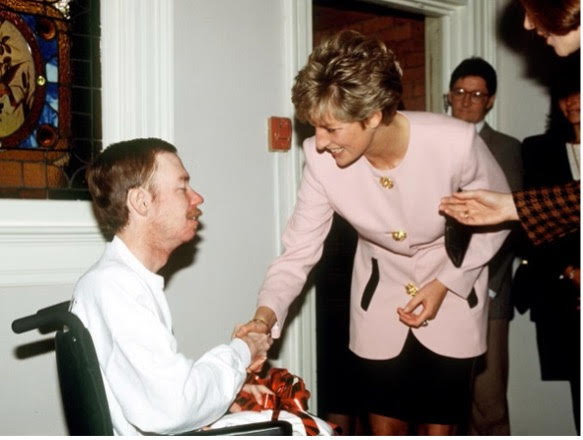
Image available at Snopes.com
Another humanitarian act by Princess Diana that deeply resonated with the public was her campaign to raise awareness about landmines. In January 1997, the global attention turned to Angola, a country devastated by a civil war since 1975, which had left over 500,000 dead and a similar number displaced. The real reason for the international media’s attention to this region was not the war itself, but Princess Diana’s visit. With support from International Committee of the Red Cross, she toured post-war minefields, walking through them in protective gear and meeting civilians who had lost limbs. Princess Diana’s primary purpose in this visit was to draw attention to the civilian casualties and horrific effects caused by landmines still active in post-war areas. Diana’s visit went far beyond symbolic significance; it both inspired and accelerated international campaigns to ban landmines. Furthermore, shortly after Diana’s death, the Ottawa Treaty, known as the Landmine Ban Convention was signed. In this context, Diana’s visit was not merely a humanitarian gesture; it also had concrete consequences in terms of foreign policy and international law.

Image available at https://www.halotrust.org/
In addition to her humanitarian work, Princess Diana changed the way the British public saw the monarchy through her lifestyle and relations with public, which were closer to the general public than a traditional royal, as seen in the intimate connections she built with the public. She never saw herself as a stranger to the public. On the contrary, she chose a lifestyle far removed from the usual royal routines. The media played a key role in reflecting her daily life and shaping public perception of the monarchy accordingly. While this media visibility served to strengthen Diana’s close relationship with the public, it also led to the tabloid consumption of her personal life. Her open emotional expressions and genuine communication captured global attention. Her ability to dress like an ordinary citizen, spend time with her children in the park, and the connect emotionally with people reshaped the image of a monarchy once seen as distant. Sometimes labeled a rebellious princess for defying royal protocol, Diana showed that warmth and authenticity could coexist with royal life. By sharing her life openly, she allowed the public to connect emotionally with a member of the royal family in a way that had never happened before, making her a truly transformative figure.
Princess Diana’s emotional connection with the public and her more personal, less traditional approach didn’t always align well within the royal family. While Diana embraced a modern and heartfelt way of relating to people, the royal family often appeared more reserved. This dynamic was profoundly affected by Princess Diana’s tragic death in 1997. Following a devastating car crash in a tunnel in Paris, her passing shocked the British public, royalty, and indeed the whole world. Almost everyone shed tears after Diana’s tragic death, and her funeral was watched by an estimated 2.5 billion people. Many condolence flowers were left after Princess Diana’s death, which the British press gave the nickname “the sea of flowers”
After Princess Diana’s tragic death, the royal family took some time to issue an official statement, which many in the British public noticed. This moment highlighted the importance of fostering a closer, more transparent, and genuine connection between the monarchy and society. During this period, the public strongly felt that Princess Diana’s humane and emotional approach filled a significant gap in society, and that the royal family should adapt to these expectations.
Princess Diana’s legacy wasn’t limited to her own time. On the contrary, she inspired many royals who came after her. Her compassionate and empathetic nature continued to shaped the upbringing of Prince William and Prince Harry, and both have followed their mother’s footsteps, taking active roles related to humanitarian aid, mental health, and social justice. The empathetical approach she championed didn’t just influence her children; it also shaped new faces of the royal family, like Meghan Markle. Furthermore, Diana showed how important it is for the monarchy to stay close and visible to the public, setting an example for contemporary royals in supporting social responsibility projects.
In light of all this, we can say that, Princess Diana remained more than just a princess within the traditional structure of the British monarchy; she became a symbol of the transformation of the public’s perception of the monarchy. Through her legacy and reflection, the royal institution acquired a more approachable and empathetic identity. There is no doubt that Princess Diana significantly influenced how the monarchy continues to stay meaningful in modern times. She was not merely a royal figure; she became the heartbeat behind a shift in how public perceived the monarchy, and her legacy continues to echo far beyond her time.
Written by Simge Naz Ertem, a student from the Department of Political Science and International Relations at Başkent University.
Sources:
1- The Royal Household. (n.d.). Diana, Princess of Wales. The Royal Family. https://www.royal.uk/diana-princess-wales
2- BBC. (2021, 8 March). Who was Princess Diana? BBC Newsround. https://www.bbc.co.uk/newsround/56239664
3- BBC. (2024, 12 January). Princess Diana’s 1997 landmine walk: ‘I come with my heart’. BBC. https://www.bbc.com/culture/article/20240112-princess-dianas-1997-landmine-walk-i-come-with-my-heart
4- BBC News. (2017, 5 April). How Princess Diana changed attitudes to Aids. BBC. https://www.bbc.com/news/av/magazine-39490507



 International angles
Leave a comment