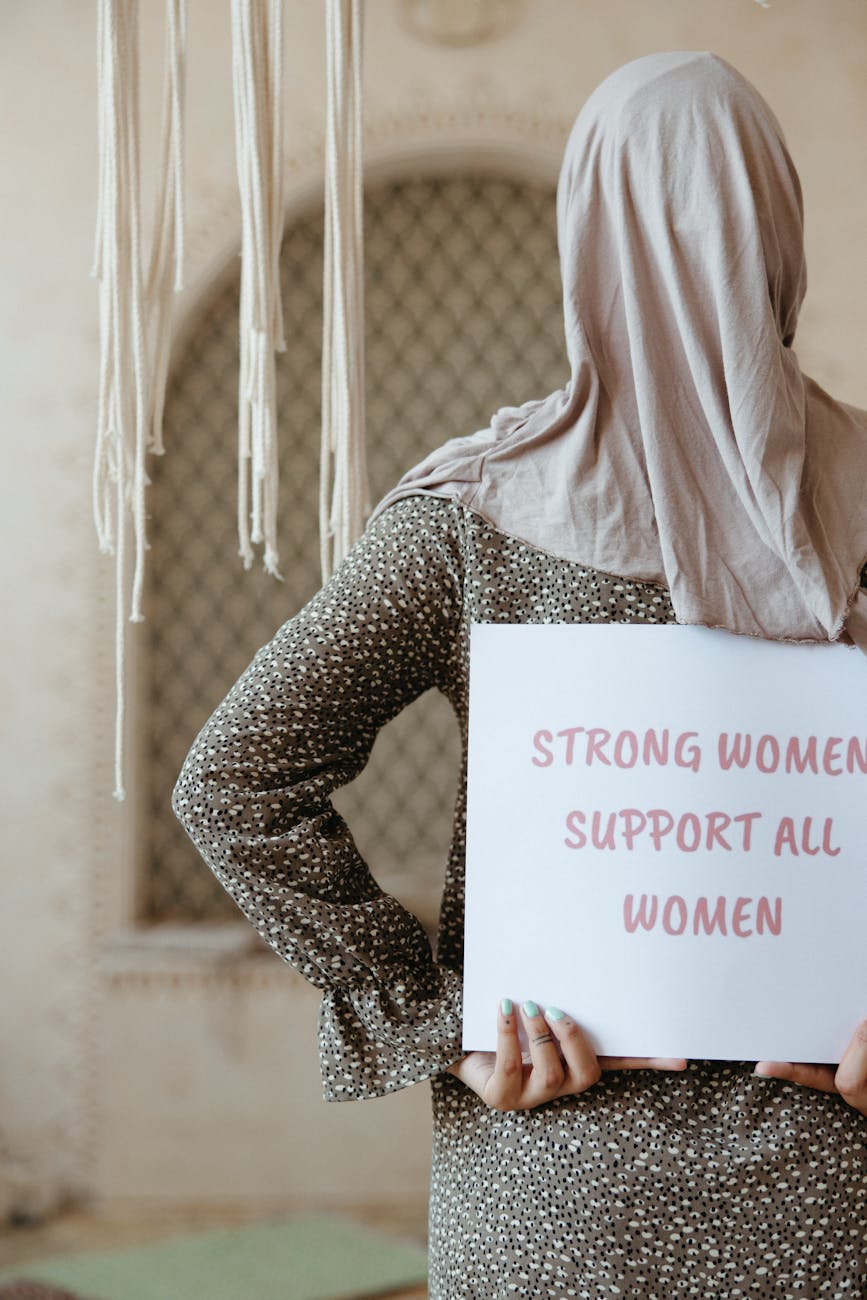
When you hear the words Islam and feminism, do they sound like opposites? For many years, they were treated as if they couldn’t possibly belong in the same sentence. And yet, over the last three decades, a vibrant movement has emerged across the Muslim world and beyond: Islamic feminism. Born in the early 1990s and still evolving, this current thought and activism is led by women who are reinterpreting sacred texts, reclaiming forgotten histories, and demanding justice, all without abandoning their faith. Far from being a contradiction, Islamic feminism is proving to be a powerful tool for reshaping gender relations in Muslim societies.
What Exactly Is Islamic Feminism?
At its core, Islamic feminism starts from a bold yet simple idea: the Quran does not endorse women’s oppression. On the contrary, it carries a message of justice, equality, and dignity.
The problem, argue Islamic feminists, lies not in Islam itself but in patriarchal interpretations of its sacred texts. For centuries, religious authority was monopolized by men, who shaped Islamic law and traditions through their own lens. The result was a distorted version of Islam that often excluded women’s voices and reinforced male dominance.
Islamic feminists are challenging this by going back to the sources: the Quraan, the Sunna, and the hadith. Feminists reread them through a gender lens, and in doing so, they’re turning the same tools traditionally used to justify restrictions on women into weapons of emancipation.
Islamic feminism didn’t emerge in a vacuum, and it was not separated from outside events. In fact, it took shape in response to three major forces that marked the transition from the 20th to the 21st century: the rise of conservative Islamist movements which often promoted retrograde and patriarchal visions of society; criticism of Western universalism which many Muslim women saw as dismissive of their cultural and religious identity; and, the return of religion to the public and private sphere as Islam regained visibility in political and social life.
In this context women began to push back – instead of abandoning their faith, they sought to reclaim it, proving that belief and equality can coexist.
A Forgotten History of Rights
Contrary to popular stereotypes, Islam was revolutionary for women in its early days. Islamic feminists love to point out that in the 7th century, the Prophet Muhammad introduced reforms that radically improved women’s status compared to pre-Islamic Arabia.
Among them: a ban on forced marriages, the right for women to inherit property, the condemnation of female infanticide, a limitation on polygamy, tied to strict conditions of justice and equality, the right for women to initiate divorce if neglected, and the guarantee that a woman’s dowry was her personal property.
Moreover, the Quran never blames Eve for humanity’s “original sin”, which is a belief imported from Judeo-Christian traditions. Instead, men and women are portrayed as equally responsible before God.
Islamic feminists also highlight the forgotten role of early Muslim women: Aisha, the Prophet’s young wife, was a theologian, political leader, and even a military commander. And during the medieval period, female scholars known as muhaddithat were respected transmitters and interpreters of hadith. In other words: women have always had a place in Islamic history. It’s patriarchy, not faith, that erased them.
Morocco: A Laboratory for Change
One of the most dynamic centers of Islamic feminism today is Morocco. In recent decades, the country has introduced reforms like the new Mudawana (family code) and the training of female spiritual guides (murchidates), both heavily influenced by feminist activism.
Two names stand out in particular: Fatima Mernissi and Asma Lamrabet.
Fatima Mernissi was an internationally acclaimed Moroccan sociologist and writer. In the early years of her career, she saw religion as an obstacle to women’s emancipation. But by the 1990s, she shifted her focus, rereading the Quran through a feminist lens. Mernissi argued that the Prophet’s community in Medina was deeply democratic, granting women full citizenship and participation in public life. The real problem, she insisted, wasn’t Islam; instead, it was the androcentric interpretations imposed by male elites over the centuries.
Asma Lamrabet, a physician and scholar, calls for what she describes as a “third way”. She recognizes the discrimination faced by Muslim women but refuses to blame Islam itself. For her, emancipation must come from within the faith, not by imitating Western secular models. She argues that Islam guarantees women all rights, but those rights have been obscured by patriarchal readings of sacred texts.
Together, their work shows that Islamic feminism is not about rejecting tradition but about reclaiming it.
Feminist or Not? The Debate on Labels
Interestingly, not all activists under this umbrella are comfortable with the term feminism. Some reject it outright, seeing it as too Western, too secular, or too tied to a universalist agenda that doesn’t fit Muslim realities. For example, Asma Barlas, a Pakistani-American scholar, warns that feminism doesn’t always offer a shared language for all women. For her, solidarity should be built around shared goals, not imposed labels. Others, like Zeinah Anwar, founder of the Malaysian group Sisters in Islam, embrace the label. In her view, it’s appropriate to talk about Islamic feminism because this activism is both inspired by global feminist struggles and rooted in Islam. Even Asma Lamrabet, though initially reluctant, acknowledges that sometimes you have to use the vocabulary that already exists if you want to be heard on the global stage. At the end of the day, the terminology matters less than the substance: in this case, a fight for gender justice within a religious framework.
The Veil: Oppression or Choice?
Few symbols spark as much debate as the veil. In Western media, the hijab is often portrayed as the ultimate symbol of female oppression. But Islamic feminists push back against this narrative. For them, the key question is not what a woman wears, but whether she chooses it freely. As they often ask: Why should wearing a hijab be seen as oppressive while wearing a miniskirt is celebrated as liberating? The problem arises when women are denied agency, whether by being forced to cover up or forced to uncover. Real liberation lies in the right to decide. This debate perfectly illustrates the tension between secular feminism, which often sees the veil as incompatible with freedom, and Islamic feminism, which defends it as potentially a form of empowerment.
Beyond Religion: Gender and Development
Islamic feminism isn’t just about religious interpretation. It’s also about politics, economics, and the future of Muslim societies.
As Asma Lamrabet points out, the decline in women’s status in Muslim-majority countries mirrors the broader decline of the Islamic world itself. In the early centuries, women were active in politics, education, and even the military. Today, many are excluded from public life.
For her and many others, restoring gender equality isn’t just a moral imperative: it’s essential for building healthier, freer, and more democratic societies. In other words, empowering women is key to unlocking broader social and economic progress.
Islamic feminism is not static. It’s constantly adapting, reshaping itself depending on context, culture, and politics. Some see it as a form of strategic positioning: a way for women to carve out space in societies where both religion and patriarchy are deeply entrenched. What makes it so powerful is its ability to offer a third way: not the wholesale rejection of religion, as some secular feminists advocate, and not the blind acceptance of patriarchal readings, as conservative Islamists demand. Instead, it’s a creative middle ground where faith and freedom can coexist.
So why should we pay attention to Islamic feminism? Because it challenges stereotypes on all sides. It shows that Muslim women are not passive victims waiting to be “saved” by the West, nor are they silent followers of patriarchal traditions. They are agents of change, scholars, activists, and leaders who are reshaping their communities from within. More broadly, it forces us to rethink what we mean by feminism itself. Must it always be secular? Must it always look the same across cultures? Islamic feminism suggests otherwise: that there are multiple paths to justice, and they don’t all have to follow the Western script.
Faith as a Tool of Liberation
Islamic feminism is, above all, a reminder that identities are complex and layered. You can be Muslim and feminist. You can fight for women’s rights without giving up your faith. In a polarized world where Islam is too often portrayed as inherently misogynistic, this movement opens up a new narrative: one where spirituality and emancipation walk hand in hand. By reclaiming sacred texts, recovering lost histories, and challenging patriarchal norms, Islamic feminists are proving that another Islam is possible, one truer to its original spirit of justice and equality. And that’s not just a win for Muslim women. It’s a win for anyone who believes that the struggle for gender justice should know no cultural or religious boundaries.



 International angles
Leave a comment