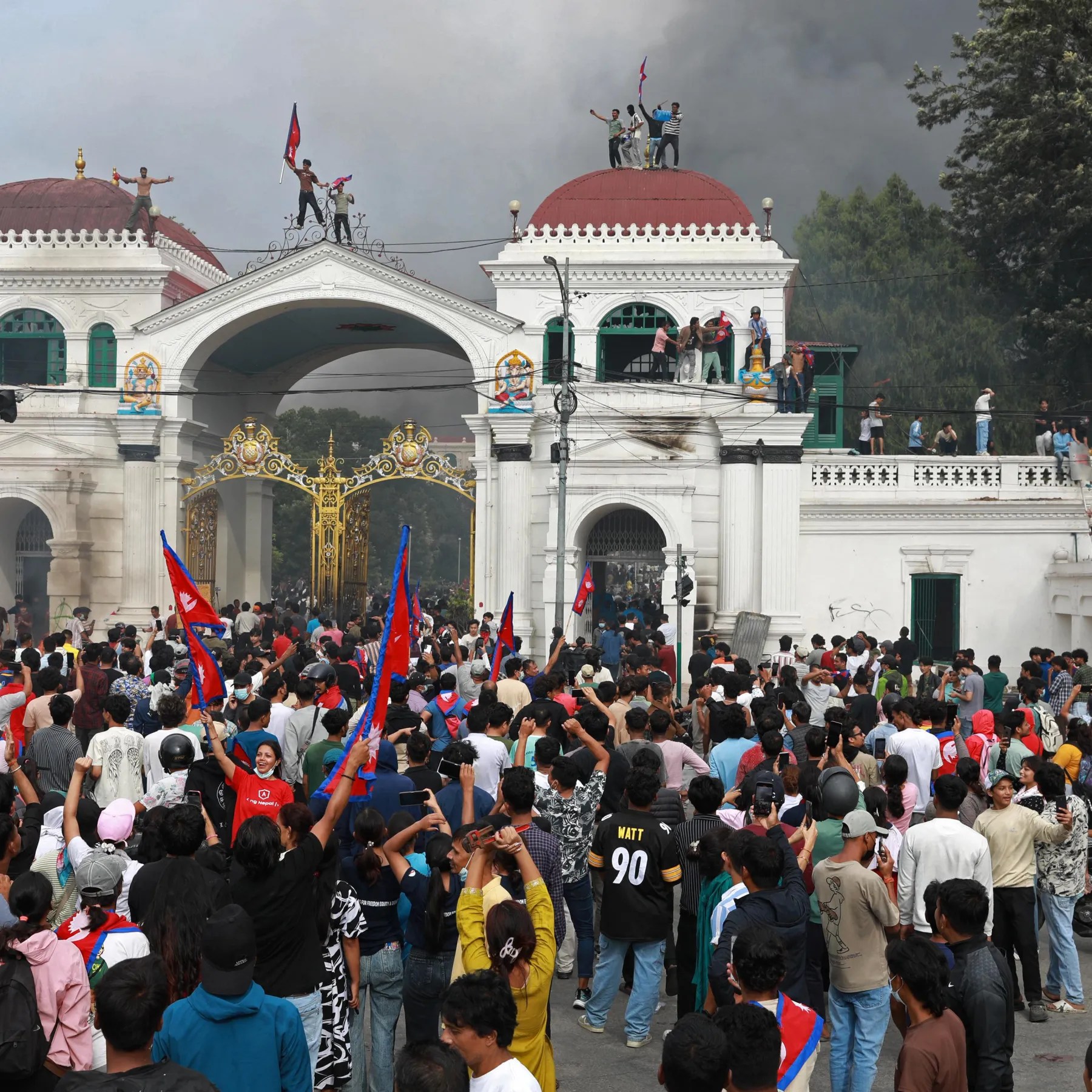
2025 has witnessed a remarkable surge of dissent worldwide, from the bustling streets of Rabat to the highlands of Nepal and the coastal urban centers of Madagascar. What’s intriguing is the timing behind all these outbreaks: beyond the year synchronism, it seems that one protest was enough to trigger a wave of rebellion all around the Globe that has plagued the second half of 2025. Hence, the tentacles metaphor represents a generational surge, a legitimate movement across continents.
This movement sheds light on a common stimulus: grievances directed at government leadership (Greene, 2025). This motivation takes separate turns when studying case by case. From the disregard of key reforms in healthcare, education, and social justice while spewing billions into football infrastructure, to water shortages and blackouts in an already long-suffering African nation (Fox, 2025), people are fed up with their governing elites.
The discontent has resulted in what is worldwide known as the Gen-Z Movement (Amnesty International, 2025). Young people are clogging the streets to fight against the corruption that is causing all aforementioned problems. The protests are loosely organized (Harter, 2025), meaning that there is no official “leader” to take accountability and get imprisoned; instead, protests are organized on popular social media platforms, such as Discord. Social media becomes the binding element that unites strangers for a common cause; moreover, it “helps people bypass authorities seeking to control flows of information” (Harter, 2025). Some say the phenomenon is reminiscent of Egypt’s 2011-2013 revolution, part of the Arab Spring, when social media
was the primary instrument of communication and interaction among participants of political protests.
Constructivism
The common feature in all cases of unrest, the prevalence of Gen Z dissidents, allows for analysis through IR theoretical lenses. As such, constructivism depicts Gen Z as a transnational identity group sharing a particular set of traits. Digitally connected, normatively oriented toward transparency, accountability, and participation, the youth are ready to repel a “broken social contract” that jeopardizes young people’s prospects for the future (Fox, 2025).
How did constructivist theory find its way into this situation? At its core, constructivism stresses that people “craft reality” through social interaction, language, and shared symbols. As such, “truths” represent constructed realities that are not fixed, but rather shaped by context, culture, and power relations. This enables identity and norms creation, and, returning to the Gen-Z context, young people’s experiences, values, and sense of “grievance” are constructed within the digital environments they inhabit, hence the sense of a transnational identity group.
Nonetheless, digital climates are not neutrally produced, but in close relation to political and cultural conditions on the ground. Below are exhibited three of the most resounding cases of Gen-Z resistance from past months, highlighting the occurrence of identity construction through digital discourse and the co-creation of meaning online.
Nepal
September 2025 was the start of Nepal’s political crisis, triggered by the government’s ban of 26 major social-media platforms, an act perceived as an ambush on digital expression. The turmoil was, however, a powder keg just waiting for a spark; young demonstrators in Kathmandu and elsewhere in Nepal voiced additional grievances, including corruption, nepotism, and an elite political class seen as out of touch, core infractions behind the attack on the digital sphere upon which this generation depends (Kharel, 2025).
Constructivism teaches about the youth-protesters’ efforts of mediating reality through social media. The digital censorship epitomized a contestation of what counts as “public space” and “voice” in an attempt to conceal the core hardships in the country. Thus, Gen Z became an identity, a social construction encompassing the digitally connected, globally aware youth that rejects the old-guardian bargains and battles against their own administration’s perils. Strangers at first, protesters co-created knowledge about the state’s failures and challenged dominant discourse about governance through hashtags, posts, and video clips.
What did that materialize into? A complete shift in social reality: burned parliament buildings, the prime minister’s resignation, and a new interim government installed. Moreover, the alternation of knowledge emphasized the importance of language and symbols in bringing change. Key protest figures, such as the manga pirate flag or the students and schoolchildren joining in uniforms and carrying books, along with various anti-corruption slogans and chants, transformed how young citizens discern their own stake in politics. While fighting for reformed policy, the protest was, therefore, as much
about meaning and identity.
Morocco
Across major cities in Morocco, including Rabat, Casablanca, Agadir, Marrakesh, etc., young people took to the streets to demand better education, healthcare, and employment opportunities in a society ruled by leaders who prioritize lavish spending on football infrastructure in the context of the upcoming co-hosted 2030 World Cup. The deterioration of public services became evident following the appalling deaths of eight women in a public hospital in Agadir; the tragedy not only ignited a movement seeking to reform public service administration, but also to eradicate the system “designed to neglect the poor while allowing the rich to escape” (Al Banksi, 2025). As such,
grievances of the Gen Z 212 group – referring to the country’s international dialing code – also covered the youth’s prospects and the authority’s visibly misaligned priorities.
Identity formation in Morocco is a close resemblance to the Nepali case, being a result of shared social networks and collective grievances that have assisted the socially constructed Gen Z community. Knowledge about service failure, inequality, and corruption is co-created across social media and street protests, bypassing traditional party channels. Social reality is, again, reshaped: due to the leaderless networks and symbols of young dissent, protesters are revising the notion of “political movement”. Claiming they are not following a formal dissenting structure, voices within the Gen Z 212 bloc touch on the government’s silence and the numerous arrests given the heightened tensions in Morocco, which are repudiated by authorities because, “in their eyes, the movement did not follow the traditional path of organizations and political parties” (Chaffag, 2025).
The fight continues in Morocco, with calls on the king to dissolve the incumbent government (Chaffag, 2025). While it seems to be a continued uphill battle, it is worth mentioning that the language of transparency, accountability, and youth rights has
found its place in Moroccan public discourse following Gen Z 212’s encounters against injustice.
Madagascar
Madagascar’s Gen Z crisis erupted around everyday life failures. Recurring water shortages and lengthy power cuts disrupt daily life and youth livelihoods, pushing for revolt in the capital Antananarivo and beyond. Drawing inspiration from protests in Nepal and elsewhere, Gen Zs not only targeted the above-mentioned infrastructural flaws but also the regime’s legitimacy.
Young dissidents were seen carrying various objects while protesting, including jerrycans and tin-can lamps, items that have become “symbols of resistance” among the outraged youth (Damy, 2025). These symbols mediated social reality, exposing the constructive narrative that the youth are being left behind despite formal prosperity. Analogous to the Moroccan turmoil, the identity of Gen Zs is being constituted as agents of change, in consideration of the online organizing and street presence.
A powerful phrase has also emerged amidst the pursuit for a better life: “We don’t want power, we want light”. The Gen Z language openly reframes the social reality into a youth/state contract that, just like in Morocco’s case, underlines the new era of political movement: a community bound together by a common cause and not following the traditional pattern of politically affiliated protesting. In terms of reality, on the ground, amendments, the early outcomes are positive, with the president dissolving his government and acknowledging the youth grievances.
Conclusion
In sum, the Gen Z protest wave around the world demonstrates how grievance becomes a socially constructed, digitally mediated reality. When applying constructivist lenses to the study of dissent and grievance, stories from Nepal, Morocco, and Madagascar generate key takeaway points:
• Grievance is constructed, not given: Gen Z transforms frustration into a shared digital narrative;
• Knowledge is co-created: Social media platforms and their products shape how youth understand injustice through collective sense-making;
• Discourse and symbols reshape reality: Catchy phrases and punchy motifs redefine what counts as political movement, legitimacy, or hope;
• Young people shape collective identities: Online personas revolving around change and conflict language bring strangers together for a common aim.
The tentacles of Gen-Z grievance stretch far beyond individual countries. They represent a generation learning to craft political reality through the tools of its own time (social media), rather than through traditional party channels. While the material conditions of discontent might differ, the underlying narrative is strikingly similar: a demand for accountability, participation, and dignity.
Reference list:
CNN (2025) Gen Z protest movement explained: what’s behind the global wave of youth unrest. CNN, 4 October. Available at: https://edition.cnn.com/2025/10/04/world/gen-zprotest-movement-explainer-intl.
Amnesty International (2025) The Gen Z movement: this is why we’re risking our lives to protest. Amnesty International, 10 October. Available at:
https://www.amnesty.org/en/latest/campaigns/2025/10/the-gen-z-movement-this-iswhy-were-risking-our-lives-to-protest/.
East Asia Forum (2025) Nepal’s Gen Z protests are a call for democratic renewal. East Asia Forum, 22 October. Available at: https://eastasiaforum.org/2025/10/22/nepalsgen-z-protests-are-a-call-for-democratic-renewal/.
The Observer (UK) (2025) A wave of Gen Z protests is sweeping the world. The Observer, 5 October. Available at: https://observer.co.uk/news/thesensemaker/article/a-wave-of-gen-z-protests-is-sweeping-the-world.
Time Magazine (2025) Gen Z protests against government corruption spread worldwide. Time, 10 October. Available at: https://time.com/7322834/gen-z-protestsgovernment-corruption/.
Encyclopaedia Britannica (2025) 2025 Nepalese Gen Z Protests. Encyclopaedia Britannica. Available at: https://www.britannica.com/event/2025-Nepalese-Gen-ZProtests.
BBC News (2025a) Nepal’s Gen Z protests: what’s behind the social-media ban unrest? BBC News, 9 September. Available at:
https://www.bbc.co.uk/news/articles/cvg9n760gddo.
BBC News (2025b) Nepal protests: social-media ban lifted after deadly clashes. BBC News, 12 September. Available at: https://www.bbc.co.uk/news/articles/crkj0lzlr3ro.
Al Jazeera (2025a) ‘We want mass resignations’: Nepal’s Gen Z anger explodes after 19 killed. Al Jazeera, 9 September. Available at:
https://www.aljazeera.com/features/2025/9/9/we-want-mass-resignations-nepalsgen-z-anger-explodes-after-19-killed.
CNN (2025b) One Piece flag becomes symbol for Gen Z protesters from Indonesia to Nepal. CNN, 19 September. Available at:
https://edition.cnn.com/2025/09/19/asia/one-piece-flag-indonesia-nepal-protestersintl-hnk-dst.
CADTM (2025) Morocco’s class war: from hospital deaths to a fight for justice. CADTM, 3 October. Available at: https://www.cadtm.org/Morocco-s-Class-War-From-HospitalDeaths-to-a-Fight-for-Justice.
BBC News (2025c) Morocco’s Gen Z 212 movement challenges elite priorities. BBC News, 10 October. Available at: https://www.bbc.co.uk/news/articles/c8rv2l3me40o.
Arab Reform Initiative (2025) Gen Z 212 earthquake: youth shaking Morocco’s politics. Arab Reform Initiative, October. Available at: https://www.arabreform.net/publication/gen-z-212-earthquake-youth-shaking-moroccospolitics/?tztc=1.
Al Jazeera (2025b) ‘We don’t want power, we want lights’: Madagascar awaits post Rajoelina era. Al Jazeera, 15 October. Available at:
https://www.aljazeera.com/features/2025/10/15/we-dont-want-power-we-want-lightsmadagascar-awaits-post-rajoelina-era.



 International angles
Leave a comment