
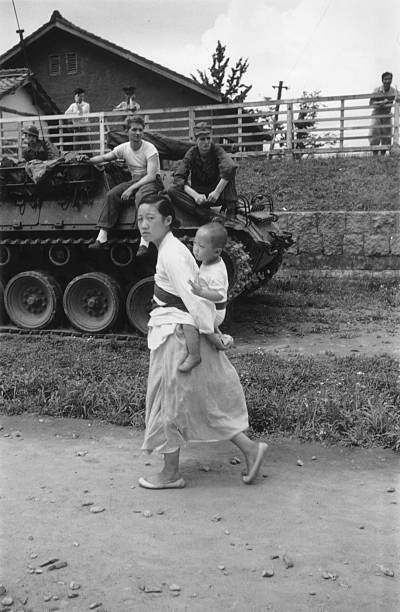

Image available at pinterest.com
Although today we refer to it as North and South, this region, once known as the Korean Peninsula, was under the occupation of the Japanese Empire between 1910 and 1945. When World War II ended, the Japanese Empire was declared an “aggressive state” and surrendered, leaving this region to the USSR and the USA. The Democratic People’s Republic of Korea was established on September 9, 1948, under the communist influence of the USSR and the leadership of Kim Il-sung. In the other part of the region, South Korea also known as the Republic of Korea, followed a capitalist regime with the great efforts of the USA. It was established by the leadership of Syngman Rhee on August 15, 1948. From this point on, we will continue to analyse how this region was shared by two completely different people over time.
The Korean War
On June 25, 1950, the Korean War began with the North’s attack on the South and continued with the participation of many countries. These states, now divided into two, had different ideologies, and their goals were also different from each other. The North’s aim was the unification of the Korean Peninsula and the spread of communism ideology. North Korea crossed the 38th parallel and attacked the South. The war was no longer just a civil war; it had turned into an ideological conflict. The cold conflict between the USA and the USSR had become a hot conflict. The war, influenced by the interests of the global superpowers, also experienced intervention by the UN. The involvement of the UN indicated that the war had gone beyond an national dimension and become a global problem. Involvement was not limited to the Western powers; Türkiye also joined the war and reinforced its commitment to the Western alliance.
The war brought about many firsts. For instance, during those years, the USSR had the right to veto in the Security Council, but it did not participate due to China’s opposition to Taiwan. For this reason, as the USSR abstained, the Security Council carried out a military intervention for the first time.
USA General Douglas MacArthur prepared the Incheon Landing Operation, which changed the course of the ongoing war.
“The Chief Commander of the US Forces in the Far East, General Douglas MacArthur, headquartered in Tokyo, visited Korea the next day and requested the Pentagon dispatch US ground troops.” (UN Involvement – UN Memorial Cemetery in Korea).
The operation began on September 15, 1950. The USA did not want communism to grow. The only way to stop this was to stop the North Korean advance. The battle was successful because the Northerners were caught unprepared, meaning the Southern forces were able to prevent the communists from gaining ground. The retaking of Seoul by UN forces was proof that the Soviets were not directing the war. After the Incheon Landing Operation in September 1950, South Korea and UN forces launched a counter-attack. It was thought that North Korea would be completely defeated. However, in November 1950, the Chinese People’s Volunteer Army joined the war to support North Korea. This event, which had a global dimension, caused the conflict to expand even further with China’s involvement. It radically changed the course of the war and forced the UN forces to withdraw. On July 27, 1953, a ceasefire was signed, but it was not a formal peace treaty. Both regions retained their independence and the war officially ended.
The absence of a formal peace treaty is evidence that the problem has no end in sight, and it could erupt at any time in the future.
Korean Peoples and a Divided Society
Today, 72 years since the ceasefire, these two peoples, despite being of the same ethnic and cultural group, have completely different societies and living conditions.
These two sharply divided countries were not only separated by the demarcation of physical borders, but also politically, socially and economically. Today, both countries are very different from each other with different ideologies, forms of governance and lifestyles. In order to provide a more detailed and explanatory analysis, it would be helpful to examine each country separately. First, let’s take a look at present-day North Korea.
Today, North Korea is a totalitarian dictatorship under the leadership of Kim Jong-Un. The country has a one-party system. Political opposition is completely forbidden. Foreign media access and communication with the outside world are severely restricted in North Korea. The collapse of the USSR and international sanctions severely weakened the country’s economy, but had the opposite effect on the military industry and the nuclear weapons sector. As for the living conditions of the population, social problems such as hunger and inadequate health care are still widespread. The North Korean people live in isolation from the outside world, apart from government propaganda-based content. They have no freedom of expression. In a way, the people are restricted from freedom of life. If we look at the psychological state of the people, fear and distrust of the outside world come to the fore.
With the collapse of the USSR , its ideological influence is not very distinct in North Korea. It was replaced by the dictatorship established by Kim Jong-Un. This situation greatly affects the psychological structure of the people. Kim Jong-Un and the previous leaders have created a deep cult of personality among the people, presenting themselves as ‘godlike figures’. This has created a structure that determines all the thoughts and behaviors of the people and increased their loyalty to Kim Jong-Un.

Image available at https://dabrownstein.com
As for South Korea, “The South Korean economy was one of the poorest countries in the world after the Korean War. Following the Korean War, the South Korean economy showed slow economic recovery between 1953 and 1961, during which time it was largely dependent on U.S. foreign aid.” (Çakmak, U. Güney Kore’nin Ekonomik Kalkınmasının Temel Dinamikleri (1960-1990). (s. 151-171).
With its economy growing over time, South Korea became a democratic republic. Today, it has established good ties with foreign relations and has become a global actor. South Korea, which has a strong economy, has come to the forefront not only with its technology, automotive and electronics sectors, but also with the socio-cultural influence of K-pop. The people of South Korea have high living standards, education levels and health care, and they have free access to the outside world. The fact that their popular culture is global is at the forefront has helped South Korea to globalise.
In this article, we have examined the changing ideologies and differences between their peoples since the Korean War, not only in political and economic situations, but also in cultural, social and individual lifestyles. While North Korea follows an oppressive regime and its people struggle with terrible living standards, South Korea is in an important position in the global arena with its democratic freedoms and high level of prosperity.
The daily lives of these people, who speak the same language and share the same race, are shaped by the policies of their governments and the opportunities they provide them. Will the living standards of these two states change over time? Is there a possibility of the countries adapting to each other and getting closer in the future, or will this separation become more permanent?
We will have to see.
Written by Öykü Senem Çakırca, a student of Political Science and International Relations at Çankaya University
References
United Nations Memorial Cemetery in Korea. UN Involvement. (Copyright 2020 by UNMCK)
Çakmak, Umut. “The Key Dynamics of South Korea’s Economic Development, 1960-1990.” Süleyman Demirel University Journal of Faculty of Economics and Administrative Sciences, vol. 21, no. 1, 2016, pp. 151-171. (Accessed: March 24, 2016).


Leave a Reply